Stains that are not a cleaning job
Before you spend an afternoon on a headliner stain, work out what it is. Three of the most common patterns are not dirt at all.
A brown-edged stain spreading from a corner or the sunroof
This is a water leak, and cleaning it treats the symptom. Saturn’s own service bulletin on water leaks onto the headliner traced staining to loose, pinched or kinked sunroof drain hoses, debris-obstructed drain grommets and voids in body seam sealer — and its prescribed correction is to diagnose and repair the leak, not to clean the fabric. If your stain has a tide line, or it reappears after rain, find the water before you touch the fabric. Clean a leaking headliner and you will be cleaning it again next month, having added moisture to a panel that is already wet.
Dark blotching with a musty smell
Treat this as mould until proven otherwise, and treat it as a moisture problem. The EPA’s guidance is blunt about the principle: the key to mould control is moisture control, water-damaged materials should be dried within 24–48 hours, and porous materials that become mouldy — it names ceiling tiles and carpet — generally have to be replaced rather than cleaned. A headliner is foam-backed fabric, which is about as porous as automotive materials get. The EPA also advises avoiding breathing spores and wearing an N-95 respirator, gloves and unvented goggles when disturbing mould. If the headliner is genuinely mouldy through, re-covering it is the honest answer.
Fabric that is already sagging or bubbling
This is the adhesive failing, and it cannot be cleaned back. Chemical Guys is explicit that a sagging headliner cannot be fixed by cleaning and that sagging areas should be left for professional re-gluing. Worse, cleaning a sagging headliner accelerates it: you are adding moisture and pressure to a bond that has already let go. If a panel has dropped, stop and get it re-covered.
Why a headliner is so easy to ruin
Almost every other interior surface forgives a heavy hand. A headliner does not, and Chemical Guys’ description of the construction explains exactly why: it is fabric over a foam backing, bonded with a heat-sensitive adhesive to a rigid hardboard panel. That is a three-layer sandwich where the layer doing all the structural work is a glue that was never designed to get wet or hot.
So there are two failure modes and you control both:
- Moisture. Liquid wicks through the fabric, through the foam, and reaches the adhesive. The bond softens. The fabric droops, usually a week or two later rather than while you are working, which is why people do not connect cause and effect.
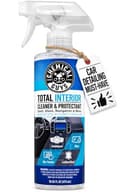
- Pressure. Scrubbing pushes the fabric away from the board mechanically and shears a bond that is already softened. Chemical Guys’ guidance is minimal pressure, straight strokes, blotting from the edges in.
Which is why the method on this page is not an ordinary upholstery method. On seats you can saturate, agitate and extract — see how to clean car seats. On a headliner you do the opposite of all three.
What never to use
Chemical Guys’ headliner guidance rules these out by name, and the reasoning follows from the construction above:
- Steam cleaners. Heat plus moisture, applied directly to a heat-sensitive adhesive. This is the single worst thing you can do to a headliner, and it is also the thing people reach for on a stubborn stain.
- Stiff brushes. Pressure and shear on a bond you cannot see.
- Bleach and harsh solvents. They will take the colour with the stain, and solvents can attack the adhesive and the foam.
- Non-fabric all-purpose cleaners. A strong APC is the right tool for a door jamb or an engine bay and the wrong one here. Use a product rated for interior fabric.
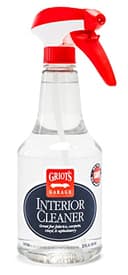
- Spraying product directly onto the headliner. Not on the banned list as a product, but it is the mistake that causes the damage. Griot’s method is a few light sprays into a towel, then dab and wipe.
One extra note for anyone with a suede or Alcantara headliner: Griot’s states those follow separate guidelines, and the vehicle manufacturer’s own instructions should win over any general detailing advice. Tesla, for instance, publishes its own interior cleaning guidance for exactly this reason.
Keeping it clean
Headliners get dirty slowly and in predictable places: around the sun visors and the grab handles where hands touch, and generally above a smoker. The low-effort maintenance is a soft-brush vacuum pass whenever you do the rest of the interior, which stops dust accumulating into something that needs a wet clean at all. If the car smells rather than looks dirty, the headliner is a surface that absorbs odour and holds it — but the answer there is source removal first, not a scented product; how to get smells out of your car covers that order, and our odour roundup sorts products by what they actually do to a smell. Worth knowing: Meguiar’s own page for its whole-car air refresher notes the mist moves through the ventilation system and across the headliner, so a fogger treats that surface without you touching it.