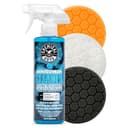
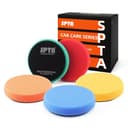
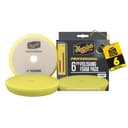
Six to eight pads for a full one-car correction, three or four for a one-step polish, and never fewer than two per stage. If you are reading this because a kit arrived with one pad and you are wondering whether that is enough: it is not, and the reason is not that makers want to sell you pads. A pad fills up with removed clear coat and spent abrasive, stops cutting, and starts generating heat instead.
What is genuinely frustrating about this question is that no maker answers it. The readable Griot’s polisher guidance says to use a fresh pad for each step and at least two pads per process when detailing a vehicle; its BOSS Hybrid Micro Polisher manual raises that to three or four per process. Nobody publishes a total for a car, a pad lifespan in hours, or a replacement interval. The counts below are that per-stage guidance multiplied out by stage.
The count, stage by stage
| Stage | Pads for a sedan | Pads for a truck or SUV | Why |
|---|
| Compound / correction | 2-3 | 3-4 | Heaviest abrasive load; a pad clogs fastest here |
| Polish / refine | 2 | 2-3 | Must be a clean pad — compound residue causes haze |
| Wax or sealant application | 1 | 1 | Dedicated finishing pad, never shared with abrasive |
| Spares for dropped or ruined pads | 1 | 1 | A pad that touches the ground is finished |
| Total, full two-stage correction | 6-7 | 7-9 | |
| Total, one-step all-in-one polish | 3-4 | 4-5 | One product, so one pad grade plus spares |
Two notes on reading that table honestly. These are our totals, built by multiplying out the maker’s per-process figures — no manufacturer publishes a per-car number, and we are not going to pretend one does. And the ranges widen with how bad the paint is: a neglected single-stage finish loads a pad far faster than a three-year-old daily driver.
Why a full pad is worse than no pad
A foam pad works because the open cells carry abrasive across the clear coat and let spent product and removed material move out of the contact patch. Once the cells pack, three things happen at once:
- It stops cutting.You keep making passes and nothing improves, so the instinct is to push harder — which is exactly wrong.
- It starts smearing. Saturated foam drags product around instead of working it, and you finish with haze you then blame on the polish.
- It heats up. A packed pad generates friction heat rather than abrasive work, and heat plus pressure plus a thin panel edge is the realistic way to damage paint with a random orbital.
That third point is why pad count is a safety topic and not a budget topic. The usual advice to work at the lowest effective speed and keep the machine moving assumes a pad that is still cutting.
The separate-pad rule
Griot’s own guidance is to use a separate pad for each machine polish, wax or sealant, so products do not contaminate one another. Treat that as a rule rather than a preference. A pad that has carried a cutting compound holds abrasive deep in the foam, and no amount of face cleaning gets it all out. Use it for your finishing pass and you reintroduce the abrasive you just finished removing.
The practical version: label them, or buy different foam lines per stage so you cannot confuse them. This is also the argument for the named-grade pads — a product whose grade is printed on it is harder to mix up than four pads distinguished only by color.
What a pad actually costs per use
The arithmetic is more cheerful than the count suggests, because pads are reusable. Take the live price of a kit above, divide by the pad count in the box, and that is your cost per pad — and a well-washed pad survives several cars. A five-pad budget kit works out to a per-pad figure in low single-digit dollars; a two-pack of premium correcting foam is several times that per pad but publishes more about what it is and survives machine washing.
That is the real buying decision: cheap pads where you expect to ruin one (learning, grit-prone lower panels, practice panels) and a named pad for the finishing pass that decides how the car looks. Our pad roundup lists face diameter, foam line and plate fitment for each so you can match them to your machine rather than guess.
A shopping list that is actually enough
For a first correction on a normal daily driver: a sampler kit for the grade spread and the pad cleaner, plus a cheap multi-pack to hit the count without spending twice. That is seven to nine pads for less than the price of two premium ones, and you will finish the car without cleaning a pad mid-panel in a panic.
If you already know your paint and your grades, buy pairs of the named grade you use and one dedicated finishing pad. And whatever you buy, keep a pad cleaner and a brush within reach of the machine — see how to use a dual-action polisher for where pad cleaning fits into the pass pattern.