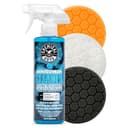
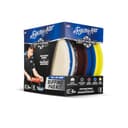
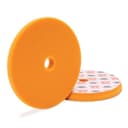
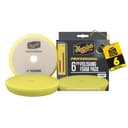
Match the pad to your plate, not to your machine
This is where the money gets wasted, so it is worth being concrete. The pad has to suit the backing plate bolted to your polisher, not the polisher’s model name. Our polisher coverage records what each machine ships with:
| If you own | Plate it ships with | Buy pads sized |
|---|
| Griot’s G9 | 6 in vented (5 in and 6 in optional) | 6.5 in — Lake Country HDO, Griot’s BOSS, CG Hex-Logic |
| Porter-Cable 7424XP | 6 in pad, 5 in counterbalance | 6.5 in, or 5.5 in on a 5 in plate |
| Chemical Guys TORQX | Ships with its own pads | 5 in / 5.5 in — Buff and Shine, SPTA |
| Adam’s Swirl Killer 15 mm | 5–6 in | 5 in or 6.5 in to match the plate you fit |
| Cordless and mini polishers | Often 3 in or smaller | 3.5 in kits — Lake Country makes an HDO version |
The rule of thumb: pad face about half an inch larger than the plate. That overhang is not decorative. It is what lets the foam flex over a body line and keeps the hard plate edge away from your clear coat. A pad the same size as the plate works on a flat hood and is unforgiving everywhere else.
What the grades actually do
Three jobs, and almost every pad on the market is somewhere on this line:
- Cutting / correcting. Dense, firm foam. Transmits energy into the abrasive so a compound can level defects. Leaves its own fine haze behind, which is why it is never the last step. Lake Country HDO and Griot’s BOSS Correcting sit here.
- Polishing. The middle. Refines what the cutting stage left and removes lighter swirls on its own. For a lot of cars this is the only stage needed — a one-step polish on a polishing pad. Meguiar’s Professional Polishing pad is this grade, named.
- Finishing. Soft, open foam with almost no cut. For applying a glaze, a sealant or a wax, and for the final gloss pass. A finishing pad with a compound on it is a waste of both.
The order is always least aggressive first. Test one section with a polishing pad and your polish. If the defects go, you are done and you never needed the cutting pad. If they do not, step up. Our compound vs polish explainer covers the chemical half of the same decision, and how to use a dual-action polisher covers the pressure and pass pattern.
How many pads do you need?
More than one per grade, and this is the most common under-buy in correction work. A pad loads up with spent abrasive, removed clear coat and residue; past a certain point it stops cutting and starts smearing and hazing. On a full car you want to swap to a clean pad every panel or two, which means two to three pads of your working grade, not one.
Practical minimum for correcting one car properly: two or three pads of your main working grade, one finishing pad, and a pad cleaning brush or the kind of cleaner that comes in the Hex-Logic sampler. That is also why the per-pad price matters less than it looks — a 3-pack at a higher unit price can be the cheaper way to actually finish the job.
Pad care, because pads are reusable and people throw them away
Clean a pad as soon as you finish with it, while the residue is still soft. Rinse it, work the foam gently to release trapped compound, squeeze — do not wring or twist, which tears the foam from its backing — and let it air dry face up. Griot’s states its BOSS pads are machine-washable, which is the most forgiving option here; for the rest, follow whatever the listing says and default to hand washing.
Retire a pad when the foam has torn, when the hook-and-loop backing no longer grips, or when the face has gone hard and glazed. And treat a dropped pad as contaminated: a single grit particle embedded in foam turns your polisher into a scratch tool, which is the same logic that governs microfiber towel care — anything that touches your clear coat has to be clean or it is an abrasive.
What about microfiber and wool pads?
Both exist and both have a place, and neither is in this roundup — so here is the honest reason. Microfiber cutting discs cut faster than foam for a given machine and are genuinely useful on hard clear coats; wool is the traditional heavy-cut option, mostly on rotary machines. We have not included them because neither is the right first purchase for the dual-action machines this site recommends, and because we would be adding product categories without being able to tell you anything the listings do not publish. If the foam pads here are not cutting enough on your paint, the next lever is usually a more aggressive compound or a longer-throw machine, not a wool pad.
Where pads fit in the whole job
A pad cannot fix a process problem. Polishing over paint that has not been decontaminated drags bonded grit across the surface and puts in new defects while you remove old ones — so the order is wash, then decontaminate, then clay, then correct, then protect. And the reason most people are correcting at all is the wash routine: Chemical Guys’ own swirl analysis names friction from a dirty towel or gritty mitt as the root cause, and notes it shows most on dark colours. Fix that and you do this job once instead of annually.
If you have not bought a machine yet, start with the polisher roundup — and budget for pads and an abrasive in the same purchase, because a bare tool corrects nothing.
Polishing over paint that is still contaminated grinds bonded grit across the surface, so the chemical decontamination stage comes first: see our bug and tar remover roundup for the tar, sap and bug protein that has to come off before a pad touches the panel.