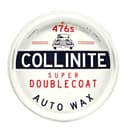
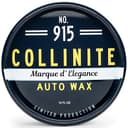
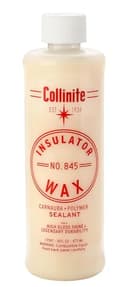
The verdict
Buy 476S. It publishes more months than 915, covers less area per ounce, and costs roughly half as much — and on everything except how dark paint looks, those are the terms of the trade. Buy 915 if your car is dark, already corrected, and the reason you wax it is that you like looking at it.
That is an unusually blunt thing to be able to say about two waxes from the same company, and it is only possible because Collinite does something almost nobody else in car care does: it publishes a durability figure in months andan average spread in square feet for every product in its range. Across the rest of this site, “lasts up to six months” is an adjective. Here it is a number you can line up and subtract.
Why this is the cleanest Collinite comparison
The other two Collinite pages on this site both have a confound in them. 845 vs 915 and 845 vs 476S are each a liquid against a paste, which means part of the answer is always about how much work you are willing to do rather than about the product.
915 and 476S remove that. Collinite’s own navigation lists 915 as “No. 915 - Marque D’Elegance Paste Wax” and its 476S page calls that product a “traditional hard paste”. Two pastes, same brand, same instruction to apply thin to clean cool paint, same “For Hand & DA Use” rating. So the decision is made entirely of things Collinite publishes: months, square feet, container sizes, and which half of a carnauba-polymer blend each one leans on.
The published figures, side by side
Every figure in this table comes from Collinite’s own product pages, read on the dates in the sources below. The 845 column is included because, for a lot of readers, it is the right answer to a question they asked badly.
| | No. 915 Marque D’Elegance | No. 476s Super Doublecoat | No. 845 Insulator Wax |
|---|
| Rated durability | 6–9 months (“2nd highest”) | 7–10 months (“highest”) | 4–7 months |
| Average spread | 1,400–2,200 sq ft | 1,200–2,000 sq ft | 1,200–2,000 sq ft |
| Form | Paste | Traditional hard paste | Liquid |
| Sizes | 12 fl oz only | 9 and 18 fl oz | 16 fl oz |
| Chemistry as described | Highest carnauba concentration in the line | Highest polymer concentration in the line | “Carnauba-Polymer Hybrid Paint Sealant” |
| Removal timing | “Minimal buffing required” | Remove at haze, “typically… 1–3 minutes” | Not published |
| Machine guidance | “For Hand & DA Use” — no pad or speed given | “For Hand & DA Use” — no pad or speed given | Finishing pad, low speed; “most machine friendly” |
| Coat interval | Not published | Not published | Minimum 12 hours between coats |
| Months figure on the Amazon listing too? | No — listing publishes none | Yes — “7-10 months of durability” | Not read this wave |
| Price band | Premium (dearest Collinite sold) | Budget | Mid |
The row that decides it
Read the first two rows together. 476S publishes a longer durability rating than 915 — 7–10 against 6–9, and Collinite ranks it “highest” against 915’s “2nd highest” in so many words. Then look at the price band. The product with the longer published life is the cheap one, by a factor of roughly two in the brackets these two sit in.
That is not how product ranges normally work, and it is worth understanding why rather than just exploiting it. Collinite is not pricing 915 as a durability product. It prices it as a concoursproduct — the FAQ describes it as having the “highest concentration of carnauba wax while still offering a high degree of polymer hydrophobic protection”, and its Amazon listing credits “#1 grade pure carnauba” with “adding reflective depth to the paint finish”. The premium is for the look, and Collinite never claims otherwise.
So the honest framing of this comparison is not “which is better”. It is: do you want nine or ten months of protection, or do you want the carnauba look? Collinite will sell you either, and it will charge you more for the one that lasts less.
Where 915 genuinely wins: the coverage row
One number on the table goes 915’s way, and it is easy to skim past. 915 is the only product in the Collinite range with a published coverage range above 1,200–2,000 sq ft — it publishes 1,400–2,200 — and it does it from the smallestcontainer Collinite sells, 12 fl oz against the 476S tin’s 9 or 18.
Collinite does not explain that, so here is our reading labeled as ours: “minimal buffing required” suggests a formula engineered to go on sparse, where 476S is a hard paste worked into 2 x 2 ft sections. The one place a concrete figure exists is the 915 listing, which is also the only place in the whole range that puts a vehicle count on a container: “a single 12 fl. oz container can cover up to 20 mid-sized vehicles.” Read “up to” as what it is.
But run the arithmetic the other way before you let coverage decide anything. Coverage per ounce favors 915; coverage per dollar does not come close.An 18 fl oz tin of 476S is both the largest container Collinite sells and the cheapest per ounce, and at 1,200–2,000 sq ft of spread it delivers far more total coverage than a 12 fl oz 915 tin at roughly half the outlay. Unless you are waxing a fleet out of one tin, the per-car cost of either paste lands somewhere between trivial and irrelevant — which is exactly why coverage is a bad reason to choose between these two and gloss character is a good one.
Carnauba against polymer, in the maker’s own words
Both of these are carnauba-polymer blends. Collinite describes 476S as a “classic carnauba/polymer blend” with the line’s highest polymer concentration, and 915 as the line’s highest carnauba concentration while “still offering a high degree of polymer hydrophobic protection”. Same two ingredients, opposite ends of the same dial.
What that dial does to a panel is not Collinite’s explanation but it is a documented one. Chemical Guys’ own wax explainer puts it plainly: natural carnauba produces a warm, deep gloss and needs more frequent reapplication, while engineered synthetic protection bonds harder and lasts longer. Every figure on the table above is consistent with that — the carnauba-led product is rated for fewer months and sold at a higher price, which only makes sense if what you are buying is the finish.
Two caveats before you spend the premium. Wax fills nothing.Carnauba depth on black paint shows the swirls underneath it more clearly, not less, because a wetter finish reflects more sharply. Correct the paint first — our swirl removal guide is the method, and a dual-action polisher is the tool. And Collinite itself suggests topping 915: the FAQ recommends following it with S-845 Speed Wax “for added shine and durability”. A company recommending a second product over its own show wax is the clearest available signal that 915 is a looks purchase rather than a protection ceiling.
The listing asymmetry, and what to take from it
One difference between these two products has nothing to do with chemistry and everything to do with what you can verify before you buy.
The 476S Amazon listing repeats the maker’s durability figure.Its own feature text reads: “Collinite 476s Wax’s high-endurance polymers provide 7-10 months of durability, long-lasting hydrophobics and UV surface heat protection commonly found only in ceramic coatings.” Retailer and manufacturer agree, which is the weakest possible form of corroboration and still better than nothing.
The 915 listing publishes no months figure at all.What it offers instead is a testing claim — “durability-tested in everyday, FOUR SEASON driving conditions and non-garaged environments (not just controlled lab settings)” — with no result attached to the test. That is why the spec row on our 915 product card reads “Not published” while the 476S row does not, and it is a small point in 476S’s favor.
There is a less flattering reading of listing copy generally, and it is visible right here. Both listings carry near-identical sentences claiming the product “uniquely bonds to surfaces without the pre-requirement for paint to be 100% ‘surgically’ clean”, and both credit “#1 grade pure carnauba” with adding “reflective depth”. The word uniquelyappears on two different products in the same range. Treat listing prose as marketing with a shared template, weigh the maker’s own spec pages more heavily, and notice when the two sources disagree — because the gaps are where the real information is.
What Collinite does not publish for either
The data here is unusually good by the standards of this category and it still stops well short of complete. For both 915 and 476S, Collinite publishes:
- No test method behind any durability figure.No climate, no wash frequency, no panel orientation, no coat count. “7–10 months” is a rating on an undisclosed basis, and so is “6–9”.
- No cure time and no coat interval for either.845 gets a 12-hour minimum between coats; these two get nothing, so there is no stated answer to “when can I put a second coat on”.
- No pad type and no machine speed.Both are rated “For Hand & DA Use” and neither page says which pad or what speed. 845 is the only Collinite that gets that guidance.
- No application temperature rangefor either, and no ingredient percentages anywhere — “highest carnauba” and “highest polymer” are relative to the rest of the line, not numbers.
- No numeric comparison between the two.Collinite ranks its own range by “degree of durability” and by months and never publishes a side-by-side it stands behind. The table above is ours, assembled from separate product pages.
- No guidance on layering one over the other.The FAQ pairs 915 with S-845 Speed Wax and says nothing about 476S underneath it, so any layering plan is your inference, not Collinite’s instruction.
None of that makes the figures useless. A maker rating with no disclosed method is still better than the adjective most brands offer, and the internal ordering — 476S above 915 above 845 — is Collinite ranking its own products against each other, which it has no commercial reason to get backwards. Read 6–9 and 7–10 as a published ordering rather than a promise, and let the price band do the rest of the work.