How to choose a pressure washer for your car
Start by throwing out the instinct to buy the highest PSI you can afford. A car needs a washer that pre-rinses, drives a foam cannon and cleans the wheels — all of which a mid-range electric unit does comfortably. The four things that actually matter are pressure (in the right range, not the highest), flow, the fitting your cannon needs, and build quality. Get the first three right and almost any decent electric washer will serve you for years.
PSI: enough, not maximum
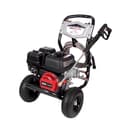
For car paint, the useful window is roughly 1,500–2,200 PSI. That is plenty to strip road film and run a cannon, while staying below the pressure that can damage clear coat, force water into seals and bearings, or peel a badge. Every electric pick on this list sits in or just above that range. The moment you climb into the 3,000-plus PSI territory of gas machines, you have bought power a car can only be harmed by — which is exactly why our “skip this” pick is a gas unit.
GPM is the spec that decides your foam
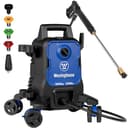
Flow rate — gallons per minute — is the number nobody reads and the one that makes or breaks a foam pre-wash. Thick, clinging foam needs water volume to carry aerated soap onto the panel; a high-PSI machine with low flow still spits thin, wet suds. For detailing, look for roughly 1.2–2.0 GPM. It’s why the Westinghouse, with a published 1.76 GPM, foams better than a cheaper unit rated at 1.1 GPM even though their PSI figures look similar. When a listing doesn’t publish GPM, we mark it “Not published” rather than guess — an empty cell is a finding, not a gap.
Fitting: match the washer to your foam cannon
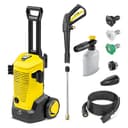
This is the single most common buying mistake. A foam cannonconnects to the washer’s lance through a quick-connect coupler — usually a 1/4-inch plug, but some brands (Kärcher and certain Ryobi models) use a proprietary bayonet fitting a third-party cannon won’t clip onto. Before you buy either piece, confirm they speak the same fitting. The tidiest way around it is a washer like the Kärcher here that shipswith a matched cannon, so there’s nothing to mismatch.
Electric or gas for a car?
Electric, almost always. For detailing, an electric washer is quieter, needs no fuel or oil, starts with a switch, and its pressure sits in the safe range for paint. Gas washers exist to clean concrete, siding and fences — jobs that want 3,000-plus PSI and huge flow. On a car that power is a hazard, not a feature. Unless you also have a driveway or deck to strip and understand you must keep a gas washer well back from paint, buy electric.
Using a pressure washer on paint safely
The washer makes the wash safer only if you use it with restraint. Keep the nozzle at least a foot from the paintand use a wide-angle tip (the 25° or 40° nozzle, or the soap nozzle for foam) — never the pencil-thin 0° tip, which concentrates enough force to mark paint and blow water past seals. Work the foam pass first, let it dwell, then rinse top to bottom. The pressure washer’s job is to loosen and rinse, not to scrub; the contact cleaning still belongs to a careful two-bucket washwith a plush mitt. Pair the machine with a soap built to foam — see our best car wash soappicks for the shampoos that produce the thickest suds through a cannon — and the whole wash step drops a tier in risk. For where this fits in the full routine, the complete detailing process walks the wash to protect order end to end.
Do you actually need one?
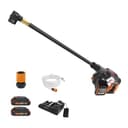
For a genuine foam-cannon pre-wash, yes — a garden hose can’t make the pressure that dense foam needs. But you don’t need much: a modest 1,800–2,300 PSI electric unit does everything a car asks. If you have no outdoor tap or outlet at all, a battery-powered, bucket-fed cleaner like the WORX Hydroshot is a real (if lower-pressure) workaround. What you should not do is over-buy on PSI thinking it cleans better. It doesn’t — it just gives you more ways to hurt the paint.
If thick foam is the main reason you are buying, the ranking above changes. Our pressure washers for a foam cannon re-order these same machines on published flow rate, which is the spec a cannon actually responds to.
Buying the right machine is the easy half. The half that protects your paint is technique: a pressure washer in the safe range can still force water past a seal, lift a loose trim clip or drive grit across a panel if you use the wrong nozzle at the wrong distance, and the order you work in decides how much grit is on the paint when the mitt arrives. Our guide to washing a car with a pressure washer covers nozzle choice, standoff distance and the rinse order.