Clay & Coat

Best Polishing Compound

Cutting compounds and finishing polishes compared on abrasive type, application and volume - what actually removes a defect, and what only hides it.

By Stephen V.Last updated How we pick

A compound removes paint. That is worth stating plainly, because everything else about choosing one follows from it. Swirls, scratches and oxidation are damage to the clear coat, and the only way to remove damage from a surface is to level the surface around it — which means taking a few microns of clear coat away and never getting them back.

You have a finite amount of clear coat, typically enough for a handful of full corrections over a car’s life. So the governing rule of paint correction is: use the least aggressive product that gets the result. Start with a polish; step up to a compound only if the polish will not clear the defect.

The picks below run from the one-bottle answer for a beginner, through a body-shop quart for a genuinely neglected car, to the finishing polish that makes the difference between a corrected car and a corrected car that looks it.

How this is funded:we earn a commission if you buy through our links, at no extra cost to you. It never changes which product we recommend, and we’ll tell you when we’d skip one. Full disclosure.

Quick picks

Ranked on published specs, coverage and buyer fit. Select a row to jump to the full write-up. We haven’t tested these in a lab — here is exactly what we do instead.

#ProductBest forPrice
1
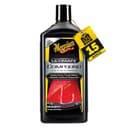
Meguiar's Ultimate Compound

Meguiar's Ultimate Compound

The default answer, and the one to buy if you are buying one. It uses diminishing abrasives that break down as you work them, so it cuts hard at first and finishes down to near-polish clarity - which is exactly what a beginner needs from a single bottle.

Best overall
$13.97 · View on Amazon

Price as of August 31, 2026. #ad How we’re funded

2
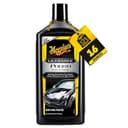
Meguiar's Ultimate Polish

Meguiar's Ultimate Polish

Not a compound at all - the finishing step that goes after one. It removes the fine haze a cutting compound leaves and brings the gloss back up before you protect the paint, and skipping it is why some DIY corrections look flat.

Best finishing polish
$9.67 · View on Amazon

$12.9926% off

Price as of August 31, 2026. #ad How we’re funded

3
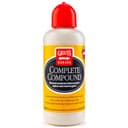
Griot's Garage Complete Compound

Griot's Garage Complete Compound

Griot's positions this for all automotive paint finishes, which matters more than it sounds - modern ceramic clear coats are harder than older paint and not every compound is formulated with them in mind.

Best for hard clear coats
$13.99 · View on Amazon

Price as of August 31, 2026. #ad How we’re funded

4
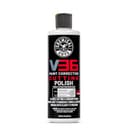
Chemical Guys V36 Optical Grade Cutting Polish

Chemical Guys V36 Optical Grade Cutting Polish

Part of a deliberate multi-step system rather than a do-everything bottle. V36 cuts, V38 finishes; if you want the results a professional two-stage correction gives, this is the honest way to get there.

Best two-stage system
$21.99 · View on Amazon

Price as of August 31, 2026. #ad How we’re funded

5
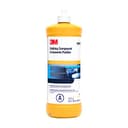
3M Rubbing Compound 05973

3M Rubbing Compound 05973

The body-shop bottle. A full quart of genuine cutting compound at a price per ounce nothing else here matches - the pick if you are correcting a whole neglected car rather than spot-treating a door.

Best value in volume
$35.99 · View on Amazon

$37.885% off

Price as of August 31, 2026. #ad How we’re funded

The picks in full

#1Top pick — Best overall

Meguiar's Ultimate Compound

The default answer, and the one to buy if you are buying one. It uses diminishing abrasives that break down as you work them, so it cuts hard at first and finishes down to near-polish clarity - which is exactly what a beginner needs from a single bottle.

Strengths

  • Diminishing abrasives cut then refine, so one product does two jobs
  • Works by hand or by machine, which is rare in a true compound
  • Cheap and stocked in every parts store

Trade-offs

  • Less outright cut than a dedicated professional compound on deep defects
  • Meguiar's does not publish a cut grade or abrasive spec
What it isDiminishing-abrasive compound, hand or machine, 15.2 oz
Size15.2 oz
CoverageNot published
Abrasive typeDiminishing
ApplicationHand or machine
Cut gradeNot published

Specs read from the product listing, on August 18, 2026. “Not published” means the brand does not state that figure.

#2Best finishing polish

Meguiar's Ultimate Polish

Not a compound at all - the finishing step that goes after one. It removes the fine haze a cutting compound leaves and brings the gloss back up before you protect the paint, and skipping it is why some DIY corrections look flat.

Strengths

  • Cheapest way to add the finishing step most DIY corrections skip
  • Safe on dark paint where compound haze shows most
  • Works by hand or machine

Trade-offs

  • Has almost no cut - it will not remove swirls on its own
  • An extra step and an extra pass over the whole car
What it isFinishing polish for after compounding, 16 oz
Size16 oz
CoverageNot published
Abrasive typeFine finishing
ApplicationHand or machine
Cut gradeFinishing (no meaningful cut)

Specs read from the product listing, on August 18, 2026. “Not published” means the brand does not state that figure.

#3Best for hard clear coats

Griot's Garage Complete Compound

Griot's positions this for all automotive paint finishes, which matters more than it sounds - modern ceramic clear coats are harder than older paint and not every compound is formulated with them in mind.

Strengths

  • Rated by the manufacturer for all automotive paint finishes
  • Pairs naturally with Griot's own polisher and pad ecosystem
  • Finishes cleanly enough that a separate polish step is often optional

Trade-offs

  • Best results need a machine - it is less effective by hand than Meguiar's
  • Cut grade is not published
What it isMachine compound rated for all automotive paint finishes
SizeNot published
CoverageNot published
Abrasive typeNot published
ApplicationMachine
Cut gradeNot published

Specs read from the product listing, on August 18, 2026. “Not published” means the brand does not state that figure.

#4Best two-stage system

Chemical Guys V36 Optical Grade Cutting Polish

Part of a deliberate multi-step system rather than a do-everything bottle. V36 cuts, V38 finishes; if you want the results a professional two-stage correction gives, this is the honest way to get there.

Strengths

  • Designed as the cutting stage of a defined two-step system
  • Optical-grade abrasives aimed at leaving minimal haze for the finishing step
  • Also sold bundled with the V38 finishing polish

Trade-offs

  • Really wants the second product to reach its intended finish
  • More expensive route than a single all-in-one compound
What it isCutting stage of a two-step correction system, 16 oz
Size16 oz
CoverageNot published
Abrasive typeNot published
ApplicationMachine
Cut gradeCutting (stage 1 of 2)

Specs read from the product listing, on August 18, 2026. “Not published” means the brand does not state that figure.

#5Best value in volume

3M Rubbing Compound 05973

The body-shop bottle. A full quart of genuine cutting compound at a price per ounce nothing else here matches - the pick if you are correcting a whole neglected car rather than spot-treating a door.

Strengths

  • 1 quart (32 fl oz) - vastly more product per dollar than consumer bottles
  • Genuine body-shop cutting compound with real correction ability
  • Long shelf life, so buying big is not a gamble

Trade-offs

  • Aggressive - it will haze soft paint and needs a polish step afterwards
  • Not a beginner's first bottle; easy to remove more clear coat than intended
What it isProfessional cutting compound, 1 qt (32 fl oz)
Size1 qt (32 fl oz)
CoverageNot published
Abrasive typeNot published
ApplicationMachine
Cut gradeCutting (rubbing) compound

Specs read from the product listing, on August 18, 2026. “Not published” means the brand does not state that figure.

Compound, polish, or one-step?

The words get used loosely, so here is the useful distinction. A compoundhas coarse abrasives and real cutting power — it removes defects and leaves behind a slight haze. A polish has fine abrasives, removes that haze and restores gloss, but has almost no cut of its own. A one-step tries to do both in a single pass, and is a genuine compromise: less cut than a compound, less gloss than a polish, but half the work. Our compound vs polish comparison goes deeper on where each belongs.

Diminishing versus non-diminishing abrasives

Diminishingabrasives break down as you work them: the product cuts hard at the start of a set and refines as the particles shrink, so one bottle does some of the job of two. That forgiving behavior is why Meguiar’s Ultimate Compound is the standard beginner recommendation. Non-diminishingabrasives cut consistently for as long as you work them — more predictable and more powerful in trained hands, less forgiving of a heavy one.

Match it to your paint, not to the label

Modern ceramic clear coats are considerably harder than the paint of twenty years ago, and a soft consumer compound can simply glaze over them without cutting. Conversely, older single-stage and lacquer paint is soft and will haze under an aggressive compound. If you are not sure, do a test section on an inconspicuous panel — a door shut or the lower rear quarter — before committing to the whole car. Note that essentially none of these brands publish a cut grade, which is why that spec row is empty across the table above.

Using a compound without wrecking your paint

Wash and decontaminate first. Compounding over bonded contamination grinds that grit into the paint under a spinning pad, which adds defects faster than you remove them. Use an iron remover, then clay if the paint still feels rough.

Then work in small sections — roughly two feet square — with a dual-action polisher. A few pea- sized drops on the pad, spread at low speed, then several slow overlapping passes with light pressure. Wipe the residue with a clean microfiber and inspect under a bright light before deciding whether to repeat. The mistake is applying more pressure rather than more passes.

Test the least aggressive combination first. Pad choice changes the outcome as much as the product: a finishing pad with a compound may be all you need, and a cutting pad with a polish is a genuine step up in aggression. Work up, never down.

Finally, compounding strips everything off the paint. The car has no protection at all when you finish, so a sealant or coatingis not optional — it is part of the same job. For the full workflow, read our paint correction guide.

Frequently asked questions

What is the difference between a compound and a polish?

Abrasive size and purpose. A compound uses coarse abrasives with real cutting power - it removes swirls, scratches and oxidation by leveling the clear coat around them, and typically leaves a slight haze. A polish uses very fine abrasives to remove that haze and restore gloss, but has almost no cut of its own. A proper correction uses both in sequence: compound to remove the defect, polish to refine the finish.

Can I use a polishing compound by hand?

You can, and some products are formulated for it, but the results are limited. Machine polishing generates the consistent speed and pressure that makes abrasives break down and cut evenly; by hand you cannot maintain either. Hand application is genuinely useful for spot-treating a single scratch or working an area a machine cannot reach. For correcting a whole car, a dual-action polisher is the difference between an afternoon and a weekend of disappointment.

How much clear coat does compounding remove?

A few microns per correction - small, but finite and permanent. A typical factory clear coat allows only a handful of full corrections across a car's life, which is why the governing rule is to use the least aggressive product and pad that achieves the result, and to correct the whole car only when it genuinely needs it. Spot-correcting individual defects rather than polishing everything is how you make that budget last.

Do I need to seal the paint after compounding?

Yes, and it is not optional. Compounding removes everything on the surface - any wax, sealant or coating is gone, and you are left with bare, freshly abraded clear coat with no protection at all. Apply a sealant, wax or ceramic coating as part of the same job. Leaving corrected paint unprotected wastes the work and exposes fresh clear coat to UV and contamination.

Which compound should I buy if I only buy one?

A diminishing-abrasive compound that works by hand or machine, because it behaves like a compound at the start of a set and like a polish by the end - so one bottle covers most of a light-to-moderate correction. Add a dedicated finishing polish when you want the last few percent of gloss on dark paint, and a heavier body-shop compound only when you meet a car that genuinely needs it.

Sources

  • Griot's Garage — How-To: PolishMachine polishing removes swirls, light scratches, water spots and oxidation; work small sections and start least-aggressive (accessed July 18, 2026)
  • Chemical Guys — How To Clay Bar Your CarClay removes bonded contaminants (brake dust, rail dust, fallout, overspray, tar, sap) that washing can't; lubricant prevents marring (accessed July 18, 2026)

Keep reading