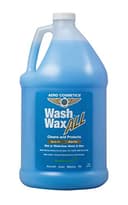
How to choose a rinseless or waterless wash
Concentrate or ready to use
This is the single biggest cost lever, and it is worth being blunt about: a ready-to-use bottle is mostly water, and you are paying to ship water. A concentrated bottle of the same product from the same brand can produce many times the number of washes for similar money. Unless you genuinely value not measuring anything, buy the concentrate. Note that most brands do not publish their dilution ratio on the listing itself, which is why the coverage column above is largely empty — check the bottle, and treat any brand that hides the ratio with suspicion.
Rinseless for dirt, waterless for dust
Match the product to the soil level honestly. A rinseless wash in a bucket gives you a large volume of lubricated solution and a place to flush the towel — that handles a normally dirty commuter car. A waterless spray gives you a few squirts and a towel, which is fine for dust, pollen and light film, and genuinely risky on anything gritty. Getting this wrong is how people conclude that rinseless washing “scratches your paint”.
Does it dilute to other jobs?
The better concentrates do double duty. Mixed stronger, several of them serve as clay bar lubricant; mixed weaker, as a quick detailer or drying aid. One bottle covering three jobs changes the value calculation considerably.
The technique that makes it safe
Rinseless washing is a technique first and a product second. Get these right and it is safe on good paint; get them wrong and you will marr it.
Use plenty of towels. The rule most people break is reusing a towel face. Fold a plush microfiber into quarters, use one face per panel section, and never return a used face to the paint. A car takes several towels. Buying a twelve-pack is part of the cost of this method, not an optional extra.
Do not scrub. Lay the soaked towel flat, draw it in one direction with almost no pressure, and let the chemistry do the lifting. Then dry that section immediately with a second, clean drying towel before moving on.
Work top-down and skip the worst areas.Rocker panels, the bottom of the bumpers and anywhere with visible road grit should be pre-treated with a spray of solution and lifted gently, or simply left for a proper wash. And wheels are always a separate job with separate tools — brake dust never comes near a paint towel.
When to say no
If the car is caked in winter salt, mud, or a layer of grit you can feel with a fingertip, no rinseless product makes it safe. Water volume is what removes that kind of soil, and there is no chemistry that substitutes for it. In that situation a coin-op pressure bay for the pre-rinse, followed by a rinseless wash at home, is a legitimate hybrid. For the full picture on what different wash methods can handle, see our rinseless vs waterless comparison.
Most people buying a rinseless wash are solving a specific logistical problem rather than shopping a category: no outdoor tap, an apartment parking space, a water restriction. If that is you, the products above are only half the answer — the method and the towel discipline are the other half, and there is one condition under which none of this is safe to attempt. How to wash a car without a hose walks through it, including how to tell when a car is simply too gritty to wipe.