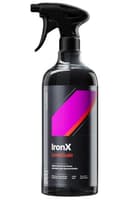
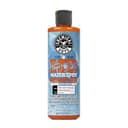
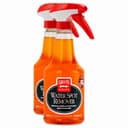
Start with a glass cleaner and two clean towels, escalate to a dedicated water-spot remover if they survive, and if they survive that, the mineral has etched and the only remaining fix is mechanical. For most cars the middle step is the answer. Work on cool glass, out of the sun, one window at a time, and rinse properly afterwards.
The reason glass is the worst surface for this is counter-intuitive. Glass is harder than clear coat, so it resists etching longer — but when it does etch, the recovery options are far worse. Paint can be polished by anyone with a dual-action polisher. Polishing a windshield risks leaving distortion in the exact place you look through.
What a water spot actually is
Three different problems share the name, and they need three different answers:
| What you have | How to tell | The fix |
|---|
| Mineral deposit on the surface | Dulls under a fingernail, catches a towel, comes off with effort | Glass cleaner, then a water-spot remover |
| Bonded deposit | Survives a cleaner; glass feels gritty rather than smooth | A remover with a published dwell time, or clay with heavy lubricant |
| Etching | Visible ring remains after everything; the glass feels smooth | Glass polishing — mechanical only. No chemical reaches it |
The diagnostic is the smoothness test. If the spot is rough, there is material sitting on the glass and a chemical has something to dissolve. If the glass feels perfectly smooth and you can still see the ring, the mineral has gone into the surface and you have stopped being able to buy your way out of it.
Why sprinklers are worse than rain
Rain is comparatively soft water and does not leave much behind. Tap water and irrigation water carry dissolved calcium and magnesium, and a lawn sprinkler hitting a parked car every morning is a mineral deposition machine: spray, bake dry in the sun, repeat. That daily cycle is why a car parked beside a sprinkler develops etching in weeks while a car that only sees rain can go years.
The same logic indicts a few common habits. Washing in direct sun lets rinse water dry on the panel before you reach it with a towel. Rinsing from the bottom up leaves the top to dry while you work. Air-drying a car instead of towelling it is, mechanically, choosing to deposit every mineral in your tap water onto the paint and glass.
Working a remover without wrecking something else
These products work by dissolving mineral, and they do not stop at the edge of the glass. Four rules make the difference:
- Cool glass, no sun. Heat accelerates the chemistry and dries the product before the dwell is up, which leaves its own residue.
- One window at a time.Apply, dwell for the time the listing states, wipe, rinse. Griot’s publishes roughly a minute and a follow-up wash; respect whatever figure is on the bottle you bought.
- Protect what is below. On vertical glass the product runs down onto trim, seals and paint. Towel or tape the line beneath, and keep rinse water ready.
- Check the coating row first. One remover on this site states it may damage ceramic coatings. If your car is coated, that bottle is not for your paint.
Gel exists for the vertical-glass problem specifically. A spray on a door window is gone into the seal before it has done anything; a clinging gel stays where you put it. If your spotting is on side glass, buy the format rather than fighting the chemistry.
Finish with the step that prevents a repeat
Removal and protection are two different jobs, and people do the first and skip the second indefinitely. A glass water repellent makes droplets bead tightly and leave the glass at speed, so far fewer of them sit still long enough to dry and deposit. That is a visibility improvement in the rain as well as a maintenance one.
Apply it only to glass you have already cleaned and de-spotted — a repellent over existing deposits seals them in. Our comparison of Aquapel vs Rain-X covers the two formats, and windshield ceramic coating covers the longer-lasting option.