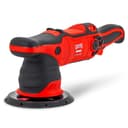
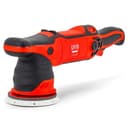
The verdict
Buy the G9. Add the G15 later, if you find that hours rather than technique are what limits you. The G15 is a genuinely better tool for one job — covering a large vehicle quickly — and a worse tool for every other job a home detailer does with a polisher, including the most common one, which is spreading a wax or sealant.
The reason is not the throw. It is the speed band Griot’s paired with the throw, and it is the figure most comparisons of these two machines never mention.
The published figures, side by side
Every figure below is from Griot’s own product pages or from the Amazon listing each machine is sold on, read on the dates in the sources. Where a row says “Not published”, we looked and Griot’s does not state it.
| | G9 Random Orbital | G15 Long Throw Orbital |
|---|
| Orbit / throw | 9 mm | 15 mm |
| Motor | 1,000 W | 1,100 W |
| Speed settings | 6 | 6 |
| Published speed range | 2,000–6,400 OPM | 3,000–5,300 OPM |
| Backing plate included | 6 in vented | 5 in BOSS fanned |
| Plate options published | Optional 5 in and 6 in vented plates | None published |
| Vibration control as described | Fan-cooled counterbalance | Precision-machined steel counterbalance |
| Cord | 10 ft quick-connect | 10 ft quick-connect |
| Box contents published | Not published anywhere we read | On the listing: plate, hex key, spare brushes, cord, manual |
| Griot’s own positioning | “Light to moderate paint correction and wax application” | “Professional-level, light to severe paint correction and paint finishing” |
| Weight | 5.0 lb / 2.27 kg without cord (2026-10-02 read) | Not published (the listing figure is a shipping weight) |
| Warranty term | Not published — “100% Satisfaction Guarantee” only | Not published — “100% Satisfaction Guarantee” only |
| Price band | Premium | Premium, and the dearer of the two |
The row almost nobody checks
Look at the speed range row again. The G9 is published at 2,000–6,400 OPM. The G15 is published at 3,000–5,300 OPM. The long-throw, higher-wattage, more expensive, professional-tier machine has a speed band that is narrower at the bottom and lower at the top.
Both ends of that cost you something concrete.
The missing bottom end.A low setting is how you spread a liquid across a section before you start working it, and it is how you apply a wax or a sealant by machine without flinging it everywhere. Collinite, for one, recommends a finishing pad at low speed for machine-applying its 845 wax. The G9 goes down to 2,000 OPM; the G15 stops at 3,000. If you want one machine that both corrects paint and applies protection — which is what most people want — the G9 is the one with the setting for the second job. See how to apply car wax for where that low speed gets used.
The missing top end. 6,400 OPM against 5,300 is the difference between a machine that can be pushed on hard clear coat and one that cannot. In fairness, a 15 mm orbit at 5,300 OPM moves the pad over far more surface per minute than a 9 mm orbit at 6,400, so the G15 is not slower in aggregate. But it is less adjustable at the end of the range where you adjust most, and it means a correction guide that specifies a high speed has no equivalent setting on the G15.
What a longer throw actually buys
One thing, and it is worth having: area per orbit. The backing plate’s center traces a 15 mm circle instead of a 9 mm one while the plate also rotates, so each pass sweeps a wider strip. Fewer passes per section, fewer sections per panel, less time per car.
Griot’s own listing puts it as “COVERS MORE AREA” and attributes it to “a 15mm orbit and large pad surface”. The first half of that is accurate and the second half is the one claim on this machine that its own spec sheet contradicts: the G15 ships a 5 in plate and the G9 ships a 6 in one. The pad surface is smaller, not larger. The coverage advantage is entirely the orbit.
A longer throw does notbuy paint safety and it does not buy forgiveness. The randomness of a dual-action orbit is what makes it hard to burn clear coat, and that randomness is present on both machines equally. A 15 mm machine is not more dangerous in the rotary sense; it is simply harder to hold flat, which is a different failure mode — pad edges that lift, marks on curves, an uneven finish on a complex panel. Our 8mm vs 15mm polisher comparison works through that across brands.
The pad-size trap
This is the practical detail most likely to cost you a Saturday, and neither Griot’s page flags it.
Pads are sold matched to a backing plate size — a 6 in plate takes the 6 in and 6.5 in pads that make up most of this site’s pad coverage, and a 5 in plate takes 5 in pads. The G9 ships a 6 in plate. The G15 ships a 5 in plate. If you own a G9, the pads in your cupboard are probably the wrong size for a G15 out of the box.
There is a fix, and it runs the other way. The G9’s Amazon listing states that it “can be converted to a 5” pad system with an optional 5” backing plate”, and Griot’s publishes optional 5 in and 6 in vented plates for it. So a two-machine garage can standardize on 5 in pads by adding a conversion plate to the G9 — whereas Griot’s publishes no plate option for the G15 at all on the page we read. If you are planning to own both, plan around 5 in pads and buy the G9 conversion plate. How many polishing pads do you need has the per-car arithmetic once you have settled the size.
Griot’s draws the line itself
One of the better things Griot’s does is publish an education page that tiers its own machines, which most brands will not do. On it, the G9 is for “Versatile, light to moderate paint correction and wax application” and the BOSS G15 and G21 are for “Professional-level, light to severe paint correction and paint finishing”. The GR3 Mini Rotary is for isolated severe defects and the G8 Mini is for tight spaces.
Two things follow. First, the tiers are about defect severity, not about skill. If your paint has swirls, light scratches and oxidation — which is nearly every daily driver — the maker’s own framing puts you in the G9 tier regardless of how good you are. Second, the same page lists orbit sizes per model and never explains what the figure means, which is a fair summary of how the whole industry treats throw: a number on a spec sheet with no stated consequence. This page exists because somebody has to connect the two.
Where the G15 is the right buy
We would not have added it to the registry if the answer were never. Three situations:
- You are correcting more than one car a year. Time compounds. A 15 mm orbit over a full-size truck is hours saved per correction, not minutes.
- You already own a short-throw machine.The G15’s weaknesses — no low setting, a small plate, awkwardness on curves — all disappear when there is another machine on the bench for those jobs. This is why it is a second tool.
- Your defects are genuinely severe.Deep swirls and heavy oxidation on hard clear coat is where Griot’s itself points at the G15 and G21. Read the swirl removal method and the compound picksbefore you blame the machine, though — a wrong pad and a finishing polish will underperform on severe defects no matter how long the throw is.
What Griot’s does not publish for either
- No warranty term for either machine.Both pages carry a “100% Satisfaction Guarantee” with the terms behind a link and no stated length. The only page on the domain we located that states a duration does it in the past tense.
- No amperage, voltage, duty cycle or run-time limitfor the G15, and none on a current read of the G9 page either — the G9’s 8.5 A figure comes from an earlier read of the same URL and is labeled as such throughout this site.
- No tool weight for the G15. The listing publishes 7.85 lb, but its length, width and height all read zero, which marks that as a shipping figure rather than a tool weight. We do not use it as one.
- No box contents on either maker page.Both Product information tabs were empty. The G15’s contents list above exists only because its Amazon listing publishes one.
- No recommended pads or liquids for either machine, and no pad-diameter guidance beyond the plate that ships.
- No noise figure, no vibration figure, no safety class for the G15(its Regulatory tab is empty), and no country of manufacture for either — though the G15 listing does say “Developed in the USA”, which is a design claim rather than a manufacturing one.
- No brush life or replacement interval, despite the G15 shipping spare motor brushes in the box.
That is a thin record from a brand that is otherwise one of the more forthcoming in car care, and it is why this page leans entirely on the handful of figures that arepublished. Griot’s will tell you the throw, the wattage, the speed band and the plate size. Those four numbers are enough to answer the question, and the answer they give is the G9 for most people.