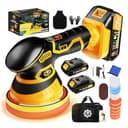
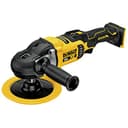
Buy the battery platform, not the polisher
This is the single most useful thing on the page. Cordless tools are sold two ways: as a kit with batteries and a charger, or as a bare tool that assumes you already own them. The same polisher can differ by hundreds of dollars between those two listings, and the bare tool is only a bargain if the batteries in your garage actually fit it.
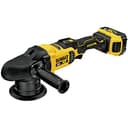
So work out what you already own before you compare polishers. If your garage runs DEWALT 20V, a bare-tool DEWALT is dramatically cheaper than any complete kit here. If you run Milwaukee M12 or M18, the same logic points at Milwaukee. Makita builds an 18V LXT random orbit polisher on the same principle. And if you own no cordless platform at all, ignore bare tools entirely and compare complete kits on what they actually include — which is how the value pick below wins.
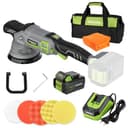
One warning about the cheap end: budget cordless polishers almost always use a proprietary battery that fits nothing else you own, and often will not fit anything you buy later either. That is not automatically disqualifying — a complete kit for under a hundred dollars is a real thing — but you are buying a closed system, and when the battery dies the tool dies with it.
Random orbit vs rotary, and why it matters more here
A random orbit machine spins and oscillates at once, so the pad never traces the same path twice. It builds heat slowly and stalls against pressure rather than digging in, which is why it is the safe default and why our dual-action polisher guide is built entirely around them. A rotary drives the pad in one direction only. It cuts much faster, and it generates heat fast enough to burn through a clear-coat edge in seconds.
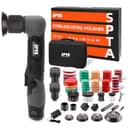
That distinction matters more in the cordless aisle than anywhere else, because the listings are worse. Tool brands state the action plainly. Several budget cordless listings do not — one of the picks below describes the same machine as a random orbital in one bullet and a rotary in another, and we have said so on its card rather than pick whichever reading suited us. If a listing will not tell you what the machine does, treat that as information about the seller. The polisher vs buffer explainer covers the difference in more depth, and how to use a DA polisher walks the technique.
Runtime is the real cordless limitation
Battery claims are made under light load. Buffing wax off is light load; cutting with a compound on a heavy pad is not, and it can draw several times the current. Treat any “up to an hour” figure as an upper bound for the easiest job the tool can do, not as a promise about correction work.
Two other cordless-specific limits are worth knowing. Small tools often carry thermal cutouts— one of the budget picks below states in its own listing that it shuts itself off after roughly twenty minutes of continuous high-speed use and needs to cool. And battery output sags as the charge drops, so the last few minutes of a pack are not the same tool as the first few. The practical answer is two batteries, which is why a kit that includes a second one is worth more than the sticker difference suggests.
When you should just buy a corded machine
If the job is correcting a whole car— swirls across every panel, a full compound-and-polish — buy corded. It is cheaper for the same capability, it does not slow down as a battery drains, and you will not stop halfway up the hood to swap packs. A corded machine plugged into an extension lead is a solved problem, and our best dual-action polisher picks are all corded for exactly that reason.
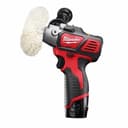
Buy cordless when the constraint is access rather than capability: a car parked away from power, a single panel, coating application, or the tight areas where you would be fighting the cord more than the defect. Plenty of people end up owning both, and the mini polisher below is the clearest example of a tool that earns its place precisely because it is not a full-size machine.
What to pair it with
A polisher is only half the job. You still need an abrasive matched to the defect — see the polishing compound picks for cutting and the swirl remover comparison for one-step correction — and the paint must be washed and decontaminated first, because polishing a dirty panel grinds whatever is on it into the clear coat. The paint correction guide sets out the whole sequence, and claying is the step most people skip before they machine anything.