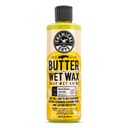
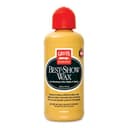
What black paint actually punishes
Black doesn’t scratch more easily than other colors. It shows more. Chemical Guys’ swirl-mark guide puts the mechanism plainly: swirls “show up most noticeably on dark colors like black and navy blue due to the contrast against light reflection.” A white car has the same fine scratches; the light bouncing off a pale surface simply drowns them out. That single fact drives almost every recommendation on this page.
1. Every pass with a towel is a risk
The root cause of swirls, per the same guide, is friction: anything abrasive moving across paint in a circular motion — a dirty towel, a gritty wash mitt, an automatic car wash brush. A wax that buffs off in one light pass therefore protects a black car in a way that has nothing to do with its chemistry. It is why our top pick is the easiest one to remove rather than the longest-lasting or the glossiest.
2. White residue is unmissable on black trim
Every car has textured black plastic trim, rubber seals and panel gaps. On a silver car, dried wax in those places is barely visible. On a black car it is a white line tracing every edge of every panel. Chemical Guys makes the point in its black-car guide when it describes its products as trim-safe: white residue, it notes, is especially visible on black cars. Two practical defenses, whichever wax you buy — apply thin coats and keep them off the trim in the first place, and tape or avoid textured plastic rather than trying to dig dried wax out of the grain afterwards. If your trim is already chalky, that is a separate job for a plastic trim restorer.
3. Dust and water spots show instantly
A black car looks dirty a day after a wash, which is the complaint every black-car owner eventually has. We looked for a published claim from any of these makers that one wax attracts or repels dust more than another, and found none — so we haven’t ranked on it, and you should be skeptical of any roundup that does. What is genuinely true is that a slick, hydrophobic finish makes dirt and water sit on the surface rather than key into it, so the next rinse takes more off with less contact. The honest version of “keeps a black car cleaner” is: it makes the wash easier, not the car self-cleaning.
Carnauba or synthetic on black?
This is the real decision, and it is a genuine trade rather than a right answer. Chemical Guys’ own comparison is that natural carnauba gives a warm, deep gloss but lasts several weeks and needs frequent reapplication, while an engineered synthetic bonds to the paint and can hold on for up to six months or more.
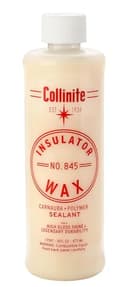
Carnauba looks better on black — that is not marketing, it is the warmth of a natural wax showing up more strongly against a dark background. Pick it if you like waxing, if the car is garaged, and if you are going to be looking at it closely. One brand lets you have most of both, and publishes the figures to prove it: Collinite rates its 915 show paste — the highest carnauba concentration in its line, and formulated for darker colors — at 6-9 months, against 4-7 for its 845 liquid. We work through that choice in Collinite 845 vs 915, and the harder version of it — carnauba depth against two or three more published months, at roughly double the price — in Collinite 915 vs 476S. Synthetic lasts longer and touches the paint less often. Pick it if the car lives outside, if you want beading through a winter, or if you know yourself well enough to admit you will not be waxing every eight weeks. A hybrid— a carnauba-plus-polymer blend like our durability pick — splits the difference and is what most people should actually buy. Our wax vs sealant comparison takes that decision apart properly if you’re torn.
For reapplication cadence, the most concrete published numbers we could source are Griot’s (three to four applications a year for its carnauba show wax, one a year for its ceramic liquid wax) and Chemical Guys’ own black-car guidance (carnauba-based every three to four months, hybrids every four to six, ceramic every six to nine, with black cars benefiting from more frequent maintenance). Treat those as the makers’ own estimates, not as measurements we made.
The wash matters more than the wax
If you take one thing from this page, take this. No wax on this list will keep a black car looking good if the car is washed badly, and almost any wax here will look great on a black car that is washed well. The prevention advice from Chemical Guys is the same advice every detailer gives: use the two-bucket method with a quality microfiber mitt, so grit is rinsed off the mitt before it goes back into the suds, and dry by blotting with a plush microfiber drying towel— or with a blower, which removes water without touching the panel at all — rather than wiping. Automatic car wash brushes are the single fastest way to swirl a black car.
The soap matters too, because the wrong one strips the wax you just applied and puts you back at the start. A pH-neutral car shampoo is what keeps a wax alive between coats; dish soap is what removes it.
Correct first, then protect — in that order
Wax shines up whatever is underneath it, including the swirls. Chemical Guys’ black-car scratch guide sets the sequence out the same way we would: decontaminate with a clay bar, then compound or polish to level defects with abrasives, then wax or seal for protection. Skipping the middle step and reaching for a gloss wax is the most common mistake on dark paint, because the filling effect is real enough to be convincing for a few weeks — and then the swirls come back exactly as they were, and it feels like the wax failed.
If your black paint has visible swirls in direct sun, you want swirl removal before any of the products on this page, not instead of them. A one-step polish on a dual-action polisher is well within reach for a first-timer, and on black it is the single change that makes the biggest visible difference — far more than swapping one wax for another.
How to wax a black car without undoing it
Griot’s method page is the one we’d follow, and it is short. Check the paint first: if it isn’t smooth to the touch, clay it before waxing. Apply thin, even coats to a cool surface with a foam or microfiber applicator — Griot’s is explicit that two to three thin coats beat one heavy coat, and a heavy coat is exactly what makes removal into scrubbing. Remove the residue with a quality microfiber towel, and on black, use more towels than you think you need: a towel that is already loaded with wax is an abrasive pad. Work in the shade on a panel you can rest your hand on comfortably. Our full how-to-apply-wax guide covers the technique in detail, and the complete detailing process shows where waxing sits in the wash → decontaminate → correct → protect order.
Should a black car just get a ceramic coating instead?
It is a fair question, and for some owners the answer is yes. A coating bonds to the clear coat and lasts years rather than weeks, which means far fewer contact events with paint that punishes contact. What a coating does not do is make black paint scratch-proof — Chemical Guys is careful to say a coating “can reduce the severity of swirl marks but won’t make paint scratch proof.” It also demands the correction step first, and on black the prep is the expensive part whichever route you take. If you’re weighing it up, start with is a ceramic coating worth it? and the coating picks themselves. If the honest answer is that you like waxing your car on a Sunday, stay with a wax — there is no prize for buying the more serious product.
Black trim fades on the same UV clock as black paint, and a wax will not fix it. If the plastic around your panels has gone gray, our Back-to-Black vs Ultimate Black comparison covers the two products most people choose between.
If you are reading this for a light-colored car, almost every criterion on this page inverts. White and silver hide the swirl marks that make effortless removal so important here, and they hide dried wax residue too, which means durability becomes the thing worth paying for instead. The picks change accordingly — see best car wax for white cars.