How to choose a foam cannon
Three things separate a cannon that foams beautifully from one that spits watery suds: the fitting, the pressure feeding it, and how adjustable it is. Get the first two right and almost any decent cannon will perform.
Fitting and quick-connect compatibility
This is the mistake people make most. A cannon connects to your pressure washer through a quick-connect coupler — usually a 1/4-inch plug, though some machines (certain Karcher and Ryobi models) use a proprietary bayonet fitting instead. Before you buy, check what your pressure washer lance accepts. Most cannons ship with the common 1/4-inch quick-connect and a few adapters, but a mismatched fitting is the number-one reason a new cannon won’t click on. When in doubt, match the cannon to your specific pressure-washer brand.
PSI, GPM and adjustability
Foam thickness comes from pressure and flow working together. A pressure washer in the roughly 1,300–3,200 PSI range with a flow of about 1.4–2.0 GPM is the sweet spot — enough pressure to aerate the soap, enough water volume to carry it. Too little pressure and the foam comes out thin and wet; that’s a flow problem, not a soap problem. A good cannon then gives you two knobs: one to change the soap-to-water ratio (how rich the mix is) and one to switch the spray from a wide fan to a tighter stream. Dial the ratio up until the foam clings and dwells without sheeting straight off. The thicker and longer it sits, the more grit it lifts before you make contact.
Do you actually need a pressure washer?
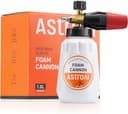
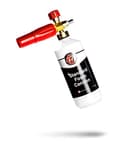
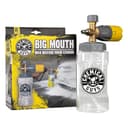
For a true cannon, yes. The dense, shaving-cream foam that clings for a minute or two only happens when a pressure washer forces soap and air through the cannon’s nozzle. A garden hose simply can’t generate that pressure. That’s why the AstroAI, Adam’s and Big Mouth on this list all require a pressure washer — it’s the engine behind the foam. Not sure which to pair with your cannon? See our best pressure washer picks for car detailing, where flow and fitting matter as much as raw PSI.
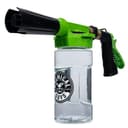
If you don’t own one and don’t want to, the answer is a garden-hose foam blaster like the TORQ Foam Blaster. It threads onto a standard hose and still coats the car in suds — just lighter foam that slides off sooner, so it dwells less. Even so, that pre-wash layer lifts far more grit than tipping soap into a bucket, which makes your contact wash safer. Whichever route you take, the foam step is only half the job: follow it with a proper two-bucket wash to remove what the foam loosened, and match your cannon to a soap built to foam. See our best car wash soap picks for the shampoos that produce the thickest suds through a cannon.
A cannon can only foam as well as the machine feeding it, and the deciding spec is flow rate rather than pressure. If you have not bought the washer yet, our best pressure washer for a foam cannon ranks machines on published GPM and names the two that do not publish it at all.
A cannon is only half the purchase. The soap decides whether the foam clings long enough to do any work, and it decides what the habit costs — a single cannon fill can consume as much product as an entire five-gallon bucket wash, so the cheapest bottle on the shelf is frequently the most expensive way to foam a car. We worked the dilution arithmetic out properly in best soap for a foam cannon.