A cannon is a pre-wash tool, not a wash
This is the misunderstanding that sells the most soap. Foam does not scrub. It softens and suspends the loose grit and road film on the surface so that the rinse can carry it away, and so that what remains under your mitt is less abrasive than it would have been. That is a genuinely valuable job — it is the step that makes a contact wash safer — but it is not a substitute for the contact wash.
A car that goes straight from foam to rinse is a car that has had a thorough rinse. If you want the paint clean, you still need the two-bucket wash afterwards, with a clean mitt and clean rinse water. The sequence that actually works: rinse, foam, dwell, rinse, two-bucket contact wash, rinse, dry. Our foam cannon guide walks through the dwell time and ratio; the snow foam vs shampoo comparison covers which chemistry belongs at which point.
Cling beats thickness
Thick foam that slides off a door in forty seconds has done almost nothing. Thinner foam that is still wet on the panel four minutes later has had four minutes of dwell time to work on road film. Dwell is the active ingredient; thickness is the photograph.
You cannot read cling off a label, and no maker on this page publishes a cling or dwell-time figure in minutes — we checked, and we are not going to invent a ranking out of marketing adjectives. What you can do is control it. Three things improve dwell more than changing soap:
- Foam a cool, shaded car. A hot panel in direct sun will dry foam before it works, and dried soap is a rinsing problem rather than a cleaning one.
- Pre-rinse first. Foam applied over a dry dust layer bonds the dust into a slurry. Foam applied to a wet car spreads and clings.
- Work bottom to top on application, top to bottom on rinse. The lower panels are the dirtiest and benefit from the longest dwell, so they should get the foam first.
The dilution arithmetic nobody does
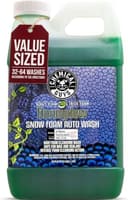
Here is the number that should decide your purchase. A foam cannon reservoir is typically around a quart; Chemical Guys lists 1 to 3 oz of Honeydew in a 32 oz solution tank, and 3 to 5 oz in a foam-lance reservoir. A bucket wash, by the same maker’s numbers, uses 1 to 3 oz in five gallons— 640 oz of water.
In other words, a single cannon fill can consume as much soap as a complete bucket wash, and some cannons consume two fills on a large vehicle. That is why “which soap is cheapest” is not answered by the price on the bottle. It is answered by price ÷ (bottle size ÷ dose), which is exactly the cost-per-wash column in the table above — computed from each maker’s published dilution against the live price, recalculated every time the price moves.
The practical consequence: buy concentrates, and buy them in the largest size you will genuinely get through. A 64 oz bottle at 1 oz per bucket beats a 16 oz bottle at 2 oz per bucket by a factor of eight, whatever the shelf price says.
Does the soap need to match the cannon or the pressure washer?
No, and this is where people spend money they do not need to. Foam quality is mostly a function of the machine and the water, not the brand on the bottle. Adam’s own foam-cannon explainer sets out the trade that actually governs it: a cannon needs flow (GPM) as much as pressure (PSI), because flow is what carries soap and air through the mixing chamber. A high-PSI, low-flow washer makes disappointing foam with the best snow foam on the market.
If your foam is thin and nothing you change in the bottle fixes it, the problem is upstream. Our pressure washers for foam cannons page covers the flow figures to look for, and the foam cannon pickscover the cannons themselves. If you have no pressure washer at all, a hose-end foam gun is the honest route — the cannon vs gun comparison explains how much foam you give up.
Will a foam cannon soap strip my wax or coating?
A pH-neutral one should not, and four of the six picks here publish a pH-neutral or pH-balanced claim plus a “safe over coatings” statement. Chemical Guys states specifically that Honeydew’s pH-neutral formula will not impact coatings and is safe on waxed vehicles.
What doesstrip protection is the stuff people reach for when the car is really dirty: dish soap, degreasers, and strong alkaline pre-washes marketed as “traffic film removers.” Chemical Guys’ coated-car guidance is explicit that strong solvents and abrasive detergents degrade a coating’s hydrophobic properties and that you should always opt for pH-neutral shampoos. We have the full answer on washing a car with dish soap (short version: it works, once, and it costs you the wax), and the picks tuned for protected paint are on best car wash soap for a ceramic coating.
What we would actually buy
If you own a cannon and wash fortnightly: Honeydew in the cannon, a gallon of a pH-neutral shampoo in the bucket. Two products, each doing the job it is built for, and the cannon fill is the only expensive part of the routine.
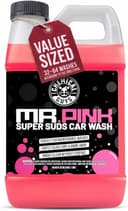
If you want one bottle on the shelf: Mr. Pink, in the biggest size you can find. You give up some cling and keep the pH-neutral safety, the lubricity under the mitt and a single dilution to remember.
And if the honest answer is that the foam is for the Instagram photo rather than for the paint — which is a perfectly good reason to own a cannon — buy the cheapest concentrate on this page and do not pretend otherwise. The paint will be just as clean afterwards, because the mitt is what cleans it. Our general car wash soap roundup ranks the same bottles for a bucket wash, where the criteria are slickness and gloss rather than foam.