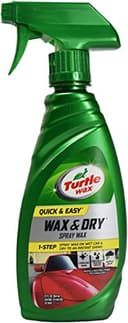
How to choose a quick detailer
Cleaner or gloss enhancer
A cleaning detailer is mostly lubricant and mild surfactant. It lifts dust and leaves nothing much behind, which is what you want when the job is genuinely to clean something. A glossdetailer adds polymers or wax that make the finish pop — excellent immediately after waxing, less ideal as an everyday duster because those gloss agents can haze on plastic trim and build up over time. Most people are better served by a cleaning detailer as their default and a gloss one for show days.
Does it double as clay lube and a drying aid?
This is where the value differences show up. A detailer slick enough to use as clay bar lubricant saves you buying a separate bottle, and one that can be misted onto a wet car as a drying aid adds lubrication exactly where drying does its damage. The multi-role bottles cost more per ounce and are usually cheaper per job.
What it is rated to touch
Check the surface list before you spray. Some detailers are paint-only; others are explicitly rated for trim and glass as well, which removes the guesswork during a fast wipe-down. Anything with wax or gloss agents in it needs more care around matte trim and textured plastic, where residue is visible and annoying to remove.
How to use one without scratching your paint
Spray the towelas well as the panel. A dry towel on a lightly misted panel is a friction problem; a damp towel gives the dirt somewhere to go. Use plenty of product — being stingy with a quick detailer is a false economy that ends in marring.
Use two towels: one to lift and spread, one clean and dry to buff. Fold each into quarters and turn to a fresh face constantly — a fold is only good for a small area, and the whole point is never to reuse a face that is already carrying grit. Work one panel at a time, and never in direct sun on a hot surface, where the product flashes off before you can buff it and leaves streaks.
Isolated bird droppings and bug splatter want a dwell, not a scrub. Lay a detailer-soaked towel over the spot for thirty seconds to soften it, then lift straight up rather than rubbing. Etched droppings that have already burned into the clear coat will not come out with a spray — that is a job for a polish.
Where a quick detailer stops
It will not remove bonded contamination — that is what clay and iron removers are for. It will not fix etching or swirls. And it adds essentially no durable protection, whatever the label implies; if you want beading that lasts, that is a spray coating or a wax, not a detailer.