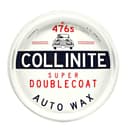
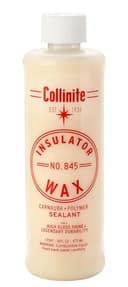
Buy No. 476S Super Doublecoat if the car lives outside, and No. 845 Insulator Wax if you will put it on with a machine. Collinite publishes a durability figure for both, and the figures are genuinely different: “7-10 months of weather protection” for 476S against “4-7 months” for 845. That is the whole decision in one line. Everything else — price, shine, the arguments on forums — is smaller than that gap.
What makes this comparison unusual is that it is possible at all. Most wax makers publish nothing about durability, which is why almost every spec table on this site has a “Rated durability: Not published” row. Collinite publishes months, and square feet of coverage, on its own product pages. Those pages are the basis for everything below.
What each one publishes
| Published spec | No. 845 Insulator Wax | No. 476S Super Doublecoat |
|---|
| Weather protection | 4-7 months | 7-10 months |
| Average spread / coverage | 1,200-2,000 sq ft | 1,200-2,000 sq ft |
| Form | Thin liquid | “Traditional hard paste” |
| Chemistry (maker’s words) | “Carnauba-Polymer Hybrid Paint Sealant” | “Classic carnauba/polymer blend” |
| Application | “For Hand & DA Use. Best results/spread found by DA” | “For Hand & DA Use” |
| Haze / removal timing | Not published (“Minimal buffing required”) | Remove at haze, “typically… 1-3 minutes” |
| Interval between coats | “Minimum of 12 hours” | Not published |
| Sizes | 16 fl oz | 9 fl oz and 18 fl oz |
| Test method behind the month figures | Not published | Not published |
Read that bottom row carefully, because it is the honest limit of this page. Collinite publishes numbers; it does not publish how it got them. There is no stated climate, no stated wash frequency and no definition of what ends “protection”. A published claim from the manufacturer is better evidence than a reviewer’s impression, and it is still a claim.
The three-month gap, and what eats it
476S claims three more months than 845. It is worth knowing what can take those three months straight back off. The single biggest variable is what you wash the car with. A pH-neutral shampoo is designed not to strip protection; a degreaser or an all-purpose cleaner is designed to. Washing a 476S car weekly with the wrong soap will beat a 845 car washed with the right one. Our car wash soap roundup is ordered on exactly that property.
Second variable: salt. 476S is the one Collinite recommends as a winter wax, and both pages name salt among the corrosives they claim to hold off. Road salt is the reason a durability wax exists at all, and it is also the reason a winter car needs washing more often, which feeds back into the soap question. Our winter washing guide covers the trade-off.
Third, and least obvious: how thin you got the coat on. Both products are sold on thin application — 476S by the 2 x 2 foot section, 845 by machine. A thick coat does not last longer. It hazes, fights you on removal, and leaves residue in panel gaps.
Liquid or hard paste is a bigger difference than it sounds
On paper this is a footnote. In a driveway it is the thing you will actually feel. 845 is a thin liquid that Collinite wants on a finishing pad at low speed; 476S is a hard paste you work by hand into a foam applicator, section by section, waiting one to three minutes for a haze each time.
If you own a dual-action polisher, 845 is close to effortless and the coverage figure means a 16 fl oz bottle is years of waxing. If you do not own a machine and are not going to buy one, 476S by hand on a sedan is a genuine afternoon — which is precisely why its 7-10 month figure is the selling point. You are buying fewer afternoons.
Which numbers are missing, and what to do about it
Neither page publishes a cure time, an application temperature range, or a maximum number of coats. 845 does publish the 12-hour minimum between coats, and Collinite notes that 845 thickens in cold and thins in heat with no stated change in performance. Beyond that you are on your own, so the sensible defaults are the usual ones: work in the shade on cool paint, do one thin coat, and leave the car dry overnight before it sees rain or a wash.
Both are protection products, not correction products. Neither removes swirls, whatever either listing implies about “removal of surface defects”. If the paint looks dull rather than unprotected, that is a paint correction job and no wax will do it.