The verdict
Buy 845 unless your paint is dark, in which case 915 earns its premium.And if what you actually want is the longest-lasting Collinite, buy neither — 476S publishes a longer durability rating than both and costs less than 915.
That is an unusual thing to be able to say with confidence about two waxes, and it is only possible because of what Collinite does that almost nobody else in car care does: it publishes a durability figure in months and an average spread in square feet for every product in the line. Across this entire site, “lasts up to six months” is normally an adjective. Here it is a number you can line up.
The published figures, side by side
Every figure in this table is from Collinite’s own product pages, read on the dates in the sources below. The 476S column is included because it changes the answer.
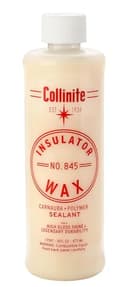
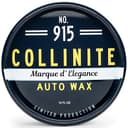
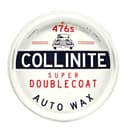
| | No. 845 Insulator Wax | No. 915 Marque D’Elegance | No. 476s Super Doublecoat |
|---|
| Rated durability | 4–7 months | 6–9 months (“2nd highest”) | 7–10 months (“highest”) |
| Average spread | 1,200–2,000 sq ft | 1,400–2,200 sq ft | 1,200–2,000 sq ft |
| Form | Liquid | Paste | Traditional hard paste |
| Sizes | 16 fl oz | 12 fl oz only | 9 and 18 fl oz |
| Chemistry as described | “Carnauba-Polymer Hybrid Paint Sealant” | Highest carnauba concentration in the line | Highest polymer concentration in the line |
| Machine guidance | Finishing pad, low speed; “most machine friendly” | “For Hand & DA Use” — no pad or speed given | “For Hand & DA Use” — no pad or speed given |
| Removal timing | Not published | “Minimal buffing required” | Remove at haze, “typically… 1–3 minutes” |
| Coat interval | Minimum 12 hours between coats | Not published | Not published |
| Price band | Mid | Premium (the dearest of the three) | Budget |
The one number that surprises people
Look at the spread row again. 915 is the only Collinite that publishes a higher coverage range than the rest of the line— 1,400–2,200 sq ft against 1,200–2,000 — and it does it from the smallest container of the three. A 12 fl oz tin covering more than a 16 fl oz bottle is not what a buyer expects from the expensive product.
There is a plausible reason, and we will label it as our reading rather than Collinite’s: a paste is applied by loading an applicator from the surface of the tin, which wastes less than pouring a thin liquid, and “minimal buffing required” suggests a formula designed to go on sparse. Collinite does not say that. What it does say, on the Amazon listing, is the thing that makes the arithmetic concrete: “a single 12 fl. oz container can cover up to 20 mid-sized vehicles.”
That is the only vehicle-count figure published anywhere in the Collinite range, which is why 915 is the one product in this comparison with a live cost-per-car figure in the table above. Treat “up to 20” as a best case. Even halved, the per-car cost of a concours paste wax lands somewhere between trivial and irrelevant — which means price per tin is a bad reason to choose between these two, and the form and the gloss character are good ones.
Why 845 is still the default
One reason, and it is not price: Collinite tells you how to machine it. Its FAQ calls 845 the company’s most “machine friendly” automotive wax, says “A finishing pad and low speed are optimal in order to obtain professional results”, and states that the best results and spread were found with a DA. The product page adds “Best results/spread found by DA” and, for hand application, “a thin layer is recommended to one section at a time”.
No other wax on this site gets that treatment from its maker. For 915 and 476S, Collinite says “For Hand & DA Use” and stops — no pad type, no speed range. So if you own a dual-action polisher, 845 is the one product in the range where you are following the manufacturer instead of guessing. On a car that gets waxed twice a year, that is worth more than two or three months of extra rating.
The 12-hour coat interval is the other piece of 845-specific guidance worth knowing: Collinite asks you to “wait a minimum of 12 hours between coats to allow the product to fully cure”. If you were planning to double-coat a car in an afternoon, plan again — and note that neither 915 nor 476S publishes an interval at all, so for those two there is no stated answer.
When 915 is worth the premium
One situation, stated narrowly: dark paint you look at. Collinite describes 915 as its “highest amount of rare carnauba” and its FAQ says it is “specifically formulated to provide a deeper show room shine to darker colored” finishes. The Amazon listing adds that the carnauba is “#1 grade” and credits it with “adding reflective depth to the paint finish”.
That matters because carnauba and polymer do different things to how light leaves a panel. Chemical Guys’ own explainer puts it plainly: natural carnauba gives a warm, deep gloss and needs more frequent reapplication, while engineered synthetic protection bonds and lasts longer. Collinite is unusual in making both in the same line, and 915 is the carnauba end of it with enough polymer to still carry a 6–9 month rating.
Two caveats before you spend the extra. Wax fills nothing.On black paint, the defect that destroys depth is swirl marks, and no carnauba hides them — it makes them wetter and more visible. Correct first, with the swirl removal method, then wax. And Collinite itself suggests topping it: the FAQ recommends following 915 with S-845 Speed Wax for added shine and durability. A maker recommending a second product over its show wax is the clearest signal available that 915 is a looks purchase.
What Collinite does not publish for either
The data here is unusually good by the standards of this category and it still stops well short of complete. For both 845 and 915, Collinite publishes:
- No test method behind any durability figure.No climate, no wash frequency, no panel orientation, no coat count. “6–9 months” is a rating on an undisclosed basis.
- No total cure time. 845 gets a 12-hour minimum between coats; neither product gets a figure for when the protection is fully formed.
- No application temperature range.845’s page notes its viscosity thickens in cold and thins in heat with no stated performance change, which is as close as the line comes.
- No maximum coat count, and no carnauba percentage or grade on the maker’s own page for 915 — “highest amount” is relative to the rest of the line, not a number.
- No numeric comparison between products.Collinite ranks its own range by “degree of durability” and by months, and never publishes a side-by-side it stands behind. The table above is ours, assembled from three separate product pages.
None of that makes the figures useless — a maker rating with no method is still better than the adjective most brands offer. It does mean you should read 4–7 and 6–9 as a published ordering rather than a promise about your driveway.