Clay & Coat

How to Wash Microfiber Towels

Fabric softener and dryer heat are what kill detailing towels, not use. How to launder microfiber so it keeps absorbing, and how to tell when a towel has to be retired.

By Stephen V.Last updated How we pick

How this is funded: we earn a commission if you buy through our links, at no extra cost to you. It never changes which product we recommend, and we’ll tell you when we’d skip one. Full disclosure.

Microfiber towels do not wear out from use. They are killed, almost always in the laundry, and almost always by one of two things: fabric softener or dryer heat. Chemical Guys’ own guidance on laundering microfiber names both — never use fabric softener, never use high dryer heat — and adds a third rule most people ignore: keep paint-safe towels separate from wheel towels.

That is the whole answer, and if you stop reading here you will get most of the benefit. The rest of this page explains why, because the mechanism is what tells you which other laundry habits are safe, and then covers the part nobody writes about: how to tell when a towel has to be retired before it costs you a panel.

What a microfiber towel actually is

A detailing towel is a blend of polyester and polyamide — typically 70/30, which is what both The Rag Company towels in our registry publish. During manufacture those fibres are split into vastly finer strands, which is where the properties come from: the split structure gives an enormous surface area that wicks water by capillary action, and the fine strands trap particles inside the pile instead of dragging them across a surface.

Both of those properties depend entirely on the fibres staying split, open and clean. That single sentence explains every rule below:

  • Fabric softener deposits a lubricating film that fills the gaps between split fibres. Capillary action stops. The towel is now a slick cloth.
  • Heat melts the tips of what is, after all, plastic. Fused tips are smooth, hard and non-absorbent — and harder than your clear coat.
  • Trapped grit stays in the pile where the towel put it, which is exactly what you want during a wipe and exactly what you must flush out afterwards.

The routine, in six steps

Follow the numbered method in the schema-marked steps above if you want it terse. The notes that matter:

  1. Sort by job. Paint towels, glass towels, interior towels, wheel towels. Wheel towels never share a drum with anything else, ever.
  2. Shake them out first, outside. Grit that goes into the machine comes back out of the machine, in the next load.
  3. Liquid detergent only. No softener, no bleach, no scent boosters. Powder detergents can leave undissolved granules in the pile.
  4. Warm wash, generous water, don’t overload. Wax and dressing residue needs warmth and room to release.
  5. Low heat or air dry, no dryer sheets. If you own one expensive plush towel, air dry it.
  6. Inspect every towel as you fold it. This is the step that prevents swirls, and it takes ten seconds a towel.

Below: the towels worth putting through that routine, and then how to tell when one of them is finished.

Towels worth laundering properly

Ranked on published specs, coverage and buyer fit. Select a row to jump to the full write-up. We haven’t tested these in a lab — here is exactly what we do instead.

#ProductBest forPrice
1
The Rag Company Edgeless 365 Microfiber Towels (10-Pack)

The Rag Company Edgeless 365 Microfiber Towels (10-Pack)

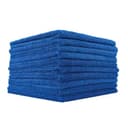
The general-purpose towel most enthusiasts settle on, and the one a beginner should own ten of rather than two. Edgeless and tagless means no hard stitched border to drag across the clear coat, and the 70/30 blend at 365 GSM is the sweet spot for buffing wax, wiping a quick detailer or drying door jambs.

Best all-purpose towel to own in quantity
$26.95 · View on Amazon

Price as of November 12, 2026. #ad How we’re funded

2
The Rag Company Dry Me A River Waffle-Weave Drying Towel

The Rag Company Dry Me A River Waffle-Weave Drying Towel

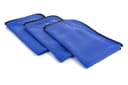
A Korean 70/30 blend waffle-weave that the enthusiast crowd has largely settled on as the default. It ships as three 16 x 24 in towels rather than one big slab, which is the sensible shape for drying: you retire a towel the moment it hits the ground instead of finishing the car with it.

Best drying towel to put through this routine
$24.95 · View on Amazon

Price as of November 12, 2026. #ad How we’re funded

3
Griot's Garage PFM Ultrafast Edgeless Drying Towel

Griot's Garage PFM Ultrafast Edgeless Drying Towel

A 1500 GSM twist pile in a 16-inch square rather than a bedsheet, which is a genuinely different idea: instead of wrestling one soaked slab around the car, you get a towel you can actually steer into door shuts, mirror caps and lower panels without it dragging on the ground. Edgeless too, so there is no stitched border to trail across the clear coat.

Highest GSM here — and the most heat-sensitive
$24.99 · View on Amazon

Price as of November 12, 2026. #ad How we’re funded

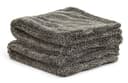
#1Top pick — Best all-purpose towel to own in quantity

The Rag Company Edgeless 365 Microfiber Towels (10-Pack)

The general-purpose towel most enthusiasts settle on, and the one a beginner should own ten of rather than two. Edgeless and tagless means no hard stitched border to drag across the clear coat, and the 70/30 blend at 365 GSM is the sweet spot for buffing wax, wiping a quick detailer or drying door jambs.

The towel the rest of your kit assumes you already have, and the one to buy in packs so you never find yourself re-using a dirty one. Published specs are unusually complete: 365 GSM, a 70/30 polyester/polyamide blend, edgeless and tagless, 16 x 16 in, ten to a pack. That 70/30 blend is the detailing standard — the polyamide fraction is what makes the fibre split and therefore what makes it absorb.

Edgeless matters more than it sounds. A stitched border is the hardest part of a towel and the part most likely to mark paint, and a sewn-in tag is worse. Ten towels is roughly the right number for one car: wax removal, interior, glass and general wiping all want their own, and a pack this size means a contaminated towel goes in the laundry basket rather than back onto the paint.

Strengths

  • Edgeless and tagless - nothing hard touches the paint as the towel ages
  • 365 GSM 70/30 blend is soft enough for wax removal and grabby enough to clean
  • The listing rates them for hundreds of wash cycles, so cost per use falls fast

Trade-offs

  • Costs several times what a big-box multipack does per towel
  • Ten towels is a starting pile, not a complete one - a full detail eats more
  • Not a drying towel; it is too small and thin to dry a whole car
What it is365 GSM edgeless all-purpose microfiber, 16 x 16 in, 10-pack
Size16 x 16 in, 10-pack
CoverageNot published
GSM365
Blend70/30 polyester/polyamide
EdgeEdgeless, tagless
Count10

Specs read from the product listing, on August 25, 2026. “Not published” means the brand does not state that figure.

#2Best drying towel to put through this routine

The Rag Company Dry Me A River Waffle-Weave Drying Towel

A Korean 70/30 blend waffle-weave that the enthusiast crowd has largely settled on as the default. It ships as three 16 x 24 in towels rather than one big slab, which is the sensible shape for drying: you retire a towel the moment it hits the ground instead of finishing the car with it.

Drying towels take the worst of the laundering cycle, because they absorb the most and get washed the most often. These publish 390 GSM, a Korean 70/30 microfiber waffle weave, 16 x 24 in, suede edges, three to a pack. A waffle weave holds water in its pockets rather than only in the pile, which is why it dries a panel in fewer passes and why it releases that water in the wash instead of hoarding detergent.

Three to a pack is the relevant number here: one car genuinely needs two drying towels, and having a third means you are never tempted to reuse a soaked one on a lower panel where the grit is. Pair with our drying guide — blotting rather than dragging is the technique that keeps both the paint and the towel alive.

Strengths

  • Korean 70/30 polyester/polyamide blend at 390 GSM - the higher-grade microfiber spec
  • Three towels per pack, so a dropped towel is retired rather than kept in service
  • ButterSoft suede edges - no thick stitched border to drag across the paint

Trade-offs

  • Costs several times what a supermarket towel does
  • Needs proper microfiber laundering (no fabric softener) to stay absorbent
  • At 16 x 24 in these are hand-sized, not one-pass slabs - expect to use two on a large car
What it is390 GSM Korean 70/30 waffle-weave drying towels, 16 x 24 in, 3-pack
Size16 x 24 in, 3-pack
CoverageNot published
WeaveWaffle
BlendKorean 70/30 microfiber
GSM390
Dimensions16 x 24 in
EdgeSuede

Specs read from the product listing, on September 3, 2026. “Not published” means the brand does not state that figure.

#3Highest GSM here — and the most heat-sensitive

Griot's Garage PFM Ultrafast Edgeless Drying Towel

A 1500 GSM twist pile in a 16-inch square rather than a bedsheet, which is a genuinely different idea: instead of wrestling one soaked slab around the car, you get a towel you can actually steer into door shuts, mirror caps and lower panels without it dragging on the ground. Edgeless too, so there is no stitched border to trail across the clear coat.

The plushest towel in our registry at a published 1500 GSM twist pile, 70/30 blend, edgeless, 16 x 16 in. A deep twist pile holds an enormous amount of water for its size, which is why Griot’s sells it on control: drying tight spaces, mirrors and lower panels without manhandling a huge towel.

It is in this list partly as a warning. The more pile a towel has, the more there is to ruin: a 1500 GSM twist pile is exactly the construction that a hot dryer cycle flattens and fuses, and exactly the one fabric softener clogs most completely. If you own one good expensive towel, this is the one to air dry rather than risk. Treat the care routine below as a condition of the purchase.

Strengths

  • Edgeless construction removes the stitched border that is the usual scratch risk on a drying towel
  • 1500 GSM 70/30 twist pile - the listing rates it at nearly 3 lb of water for a 16-inch towel
  • Small enough to keep off the ground on rockers and sills, where big towels pick up grit

Trade-offs

  • 16 x 16 inches is small for a full car - you will want more than one, or a big towel for the panels
  • Costs more than a full-size budget waffle towel despite covering less area per pass
  • A dense twist pile takes longer to dry out between washes than a thin waffle weave
What it is1500 GSM edgeless twist-pile drying towel, 16 x 16 in
Size16 x 16 in
CoverageNot published
WeaveTwist pile, 70/30 blend
Dimensions16 x 16 in
GSM1500
EdgeEdgeless

Specs read from the product listing, on September 3, 2026. “Not published” means the brand does not state that figure.

When to retire a towel

Every towel eventually becomes a liability, and the moment it does is not obvious, because a dying microfiber towel still looks like a towel. Retire or demote one when you see:

  • It stops absorbing. Water beads on the towel or runs off it instead of soaking in. This is the fabric-softener signature, and it is largely irreversible.
  • It feels stiff or slick rather than grabby. Run it over the back of your hand — a healthy microfiber towel catches slightly on dry skin. One that glides is glazed.
  • Glazed or shiny patches. Melted fibre tips from dryer heat. Those patches are now harder than your clear coat.
  • Anything you can feel in the pile. Embedded grit or metal. Do not demote this one — bin it. A particle trapped in the weave is a scratch waiting for a panel.
  • Frayed edges or a loose seam. Demote to wheels and jambs.

There is a simple hierarchy worth running in your garage: paint → glass → interior → door jambs → wheels → bin. Towels only ever move down it, never back up. Chemical Guys’ own laundering guidance makes the same separation, keeping paint-safe towels apart from wheel towels, and the reason is specific: brake dust is iron, and iron particles embedded in a towel are abrasive in a way that road dirt is not. If you want that iron out of your paint rather than ground into it, that is a chemical decontamination job, not a towel job.

Why this is a paint-protection issue, not a housekeeping one

It is tempting to treat towel care as fussiness. It is not. Chemical Guys’ own analysis of swirl marks identifies friction as the root cause — “a dirty towel, gritty wash mitt or automatic car wash brush moving in a circular motion leaves tiny scratches” — and notes that those marks show up most noticeably on dark colours such as black and navy blue, because of the contrast against reflected light. The same guidance recommends drying by blotting with a plush microfiber towel, or with a blower, rather than wiping.

Put those together and the conclusion is uncomfortable but clear: the towel is in direct contact with your clear coat more often than any other object you own, and a badly laundered towel is a fine abrasive pad you are applying by hand. Griot’s makes the same point from the wax side — its own method says to always remove wax and sealant residue with a quality microfiber cloth. Every swirl you then have to correct costs you clear coat you cannot get back. Our paint correction guide covers what that removal actually costs.

Common mistakes

  • Washing microfiber with cotton. Cotton sheds lint; microfiber grabs it. You will spend the next three details picking fluff off your paint.
  • Using bleach to rescue stained towels. A stain is cosmetic and harms nothing. Bleach degrades the fibre and shortens the towel’s life for no benefit.
  • Dryer sheets. Same mechanism as fabric softener, applied in the dryer instead of the wash. Chemical Guys’ guidance rules out both softener and high dryer heat.
  • Overloading the drum. Towels need room to move or the detergent never flushes the grit out, and grit left in a towel is the whole problem.
  • Washing wax-loaded towels on cold with cold-water detergent. Wax and dressing residue needs warm water and real detergent to release. A towel that still feels slightly waxy has not been cleaned.
  • Keeping one “good” towel for years. A towel is a consumable. Buying a ten-pack is cheaper than a single-panel correction.

How many towels do you actually need?

More than most people own, and that is the practical fix for most of the problems above. For one car, a realistic working set is two drying towels, three or four for wax and sealant removal, two for glass, two for interior, and two or three dedicated wheel towels that never touch paint. That is roughly a dozen, which is why the towels in our picks are sold in packs rather than singly.

The reason quantity matters more than quality is simple: almost every bad towel decision — reusing a dropped towel, flipping to the dirty side, drying a lower rocker panel with the towel that just did the roof — is made because there was no clean towel within reach. Our drying towel roundup compares the full set on GSM, weave and dimensions, and how to wash without scratching covers the rest of the contact chain — the mitt, the buckets and the order you work in.
Frequently asked questions

Can you use fabric softener on microfiber towels?

No. Chemical Guys' own laundering guidance is explicit that you should never use fabric softener on microfiber. Softener works by depositing a lubricating film on fibres, and on microfiber that film fills the split-fibre structure that does the absorbing. The towel stops picking up water, feels slick instead of grabby, and the damage is cumulative and largely permanent.

What temperature should I wash microfiber towels at?

Warm rather than hot for the wash, and low or no heat for the drying. Warm water with a real liquid detergent is what releases wax, dressing and polish residue - a cold wash often leaves a towel still faintly waxy. For drying, Chemical Guys' guidance rules out high dryer heat, because microfiber is polyester and polyamide and high heat melts and fuses the fibre tips. Air drying is the safest option.

Can I wash microfiber towels with regular laundry?

Do not wash them with cotton. Cotton sheds lint and microfiber attracts and holds it, so the towels come out covered in fluff that then transfers to your paint. Wash microfiber in its own load, and within that load keep paint-safe towels separate from wheel and engine-bay towels, which carry embedded brake dust.

Why do my microfiber towels not absorb water anymore?

Almost always fabric softener, dryer sheets, or high dryer heat - in that order of likelihood. Softener and dryer sheets coat the split fibres so they can no longer wick; heat melts the fibre tips so they fuse into a smooth, non-absorbent surface. Both effects are largely permanent. A towel that beads water instead of soaking it up should be demoted to wheels or jambs.

How often should I replace detailing towels?

By condition, not by calendar. Retire a towel when it stops absorbing, feels stiff or slick, shows glazed shiny patches, or has anything you can feel embedded in the pile. The last one goes straight in the bin rather than being demoted - a trapped grit or metal particle is a scratch waiting to happen. Towels are consumables, and a ten-pack costs far less than correcting one panel.

Should I separate wheel towels from paint towels?

Yes, and this is the separation that matters most. Chemical Guys' guidance specifically calls for keeping paint-safe towels apart from wheel towels. Brake dust is iron, and iron particles embedded in a towel are genuinely abrasive against clear coat in a way that ordinary road dirt is not. Keep a dedicated wheel set, wash it separately, and never promote a wheel towel back to paint.

Sources

  • Chemical Guys — How To Wash Microfiber Towels — Never use fabric softener or high dryer heat on microfiber, and separate paint-safe from wheel towels (accessed July 18, 2026)
  • Chemical Guys — What Causes Swirl Marks on Car Paint and How to Prevent Them — Manufacturer guide: friction is the root cause - a dirty towel, gritty wash mitt or automatic car wash brush moving in a circular motion leaves tiny scratches; swirl marks show up most noticeably on dark colors such as black and navy blue because of the contrast against light reflection; prevent with the two-bucket method and a microfiber mitt, and dry by blotting with a plush microfiber towel or with a blower rather than wiping; wax can temporarily fill light swirl marks and make them less visible but does not remove the underlying scratches (accessed September 29, 2026)
  • Griot's Garage — How-To: Wax — Manufacturer method: always evaluate the surface for above-surface contaminants before waxing and clay it if the paint is not smooth; apply thin even coats to a cool surface with a foam or microfiber pad, because two to three thin coats are better than one heavy coat; always remove wax and sealant residue with a quality microfiber cloth (accessed September 29, 2026)
  • Chemical Guys — Two Bucket Method Car Wash Guide — Separate wash and rinse buckets keep contaminated water off the mitt — the main source of wash-induced swirl marks (accessed July 18, 2026)

Keep reading