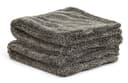
How to choose a drying towel
Start with the weave, because it decides how the towel behaves more than any number on the label does.
Waffle weave vs twist pile vs plush
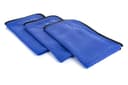
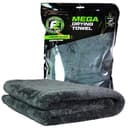
A waffle weavehas a grid of pockets that hold water and release it when you wring the towel out. Waffles are thin, dry quickly between uses, and are the traditional choice — they are also the cheapest way to get a genuinely good towel. A twist pile towel has long, twisted fiber loops that hold enormous volumes of water; these are the 1200 GSM monsters that dry a whole car in one pass and weigh a surprising amount when loaded. Plush pile sits in between: softer than a waffle, less absorbent than a deep twist pile, and the most pleasant to actually handle.
GSM is a useful number, not the only number
GSM (grams per square meter) measures how much fiber is packed into the towel. Higher GSM generally means more absorbency and a softer touch — a 1200 GSM twist pile really does hold far more water than a 300 GSM waffle. But GSM says nothing about the fiber blend or the edges, and a heavy towel is harder to maneuver. Note that most brands simply do not publish a GSM figure at all, which is why so many of the specs in the table above read “Not published”.
The blend, and why 70/30 keeps coming up
Microfiber is a blend of polyester (the scrubbing, structural fiber) and polyamide (the absorbent, softer one). A 70/30 blend has more polyamide than the common 80/20, which makes it softer and more absorbent — and more expensive. “Korean 70/30” is shorthand for the higher-grade mills that produce it. It is a real difference, not just marketing, though it matters most on dark, coated paint where fine marring is visible.
Edges matter more than people expect
A cheap towel often has a stitched polyester border. That border is harder than the pile around it, and as the towel ages it is the part most likely to leave a mark. Edgeless and silk-banded towels remove that risk entirely. If your towel does have a hard edge, keep it off the paint and replace the towel sooner.
How to dry a car without putting swirls in it
Technique does more for your paint than the towel does. Work top-down, so you are never dragging a towel that has been on the dirty lower panels back across the roof. Lay the towel flat on the panel and pat or drawit, rather than scrubbing in circles — a loaded towel does not need pressure to work. Use a second, dry towel for the final pass on glass and lower panels.
The single highest-value habit: the moment a drying towel touches the ground, it is done. It is now full of grit and it will put that grit into your clear coat. That is the real argument for buying a cheap towel in a multipack alongside your good one. A quick detailer used as a drying aidalso helps — a light mist adds lubrication so the towel glides instead of grabbing.
Wash your towels properly or they stop working
Microfiber fails from bad laundering more than from wear. Never use fabric softener: it coats the fibers and destroys absorbency permanently, and a towel that no longer absorbs just pushes water around under pressure. Wash microfiber separately from cotton, on a warm cycle, and tumble dry on low or no heat. Keep paint towels and wheel towels in physically separate piles — brake dust is exactly the contamination you spent the wash removing.
For where drying sits in the wider routine, our guide to drying a car without scratching it covers blowers, drying aids and the order of operations in more depth.
Whichever towel you buy, the laundry is what decides how long it lasts: fabric softener and dryer heat kill microfiber far faster than use does. Our guide to washing microfiber towels covers the routine and how to tell when a towel has to be retired.
There is also the option of drying without a towel at all. A car dryer blower turns a towel from the thing contacting all of your paint into a finishing tool used on a fraction of it, which is the single biggest swirl reduction available at home.