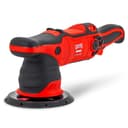
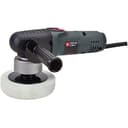
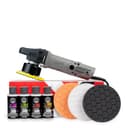
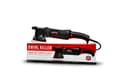
This is the most common head-to-head in DIY paint correction, and it is really a question about whether to buy the current generation or the one that defined the category. The Griot’s G9 is a modern, fully specified 9 mm long-throw random-orbital, backed by a satisfaction guarantee whose terms Griot’s links rather than publishes. The Porter-Cable 7424XP is the machine that put machine polishing within reach of ordinary owners, and it is still in production and still cheap.
We own neither tool and have run no comparative test. What we can do is read both manufacturers’ published specifications against each other — and that turns out to be genuinely decisive, partly because of what one of them leaves out.
Published specs, side by side
| Griot’s G9 | Porter-Cable 7424XP |
|---|
| Action | Random orbital (dual action) | Random orbital (dual action) |
| Orbit / throw | 9 mm | Not published by the maker |
| Motor | 1,000 W / 8.5 A | 4.5 A, AC only |
| Speed | 6 settings, 2,000–6,400 OPM | Electronic variable, 2,500–6,800 OPM |
| Speed under pressure | Constant Speed Control circuitry | Not published |
| Backing plate | 6 in vented (5 in and 6 in optional) | 6 in pad, 5 in counterbalance |
| Weight | 5.0 lb (without cord) | 5-1/2 lb |
| Cord | 10 ft quick-connect | Not published |
| Warranty | Lifetime (Griot’s) | 3-year limited, 1 year free service, 90-day satisfaction |
| In the box | Tool and backing plate — pads and polishes extra | Polishing pad, side handle, wrench |
Reading the spec gap honestly
The 7424XP’s OPM range is higher at both ends than the G9’s, and it would be easy to present that as a win. It is not, and it is worth explaining why, because this is the most misread number in polisher shopping.
OPM is pad oscillations per minute. On its own it tells you very little about correction rate, because what actually removes clear coat is the combination of throw (how far the pad travels per oscillation), torque (whether that travel continues when you press down) and the abrasive you are using. A high free-speed OPM figure is measured with no pad on the paint. The G9’s 1,000 W motor and its Constant Speed Control are aimed squarely at the second of those three — keeping the speed you selected when your arm is leaning into a hood. The Porter-Cable publishes 4.5 amps and no speed-holding claim at all.
The missing throw figure is the other half of it. Without a published orbit, the 7424XP’s OPM number cannot be converted into any statement about how fast it cuts. We are not going to import a retailer’s 8 mm figure and present it as a manufacturer spec — our review policy treats an unpublished figure as a finding. What we will say is that a 9 mm throw with a 1,000 W motor behind it is a fully described machine, and the alternative is not.
Who should buy which
Buy the Griot’s G9 if…
- You want one polisher for the next decade and would rather not upgrade twice.
- You expect to do real correction — swirls, light scratches — not just apply wax.
- A long guarantee on a tool with a motor and bearings is worth something to you — though read our G9 review first, because Griot’s publishes no warranty term on the product page and Porter-Cable publishes three years.
- You will work in long sessions, where vibration and heat are what actually stop you.
Buy the Porter-Cable 7424XP if…
- Budget is the binding constraint and the G9 is simply out of reach.
- You learn from video and want the machine that the entire tutorial canon was filmed with.
- You are polishing one car, occasionally, and noise and vibration do not bother you.
- You already own pads and compound, so the bare-tool price is the real price.
Buy neither if…
- You own no pads, no compound and no polish — get the TORQX kit instead and start this weekend.
- You are correcting a whole neglected car and want it finished — a 15 mm long-throw machine will save you hours.
- You only want to apply a wax or sealant. A polisher is a nice luxury for that and an expensive one; a foam applicator and twenty minutes does the same job.
The thing that matters more than the machine
Both of these tools, used carefully, will produce a result that looks professional. Both, used carelessly, will put holograms in your clear coat or burn through an edge. The variables that dominate your outcome are the pad and abrasive you pair with the machine, how clean the paint was when you started, and whether you worked in small sections with a clean pad. Chemical Guys’ own guidance on swirl marks makes the upstream point: friction from a contaminated towel or mitt is what causes the defects you are now correcting, so fixing the wash routine is what stops you doing this again.
So decontaminate first with a clay bar, read the correction guide, buy a decent pad set, and then worry about which of these two machines is in your hand. On the published numbers, it should be the G9.
If what you actually want to know is whether to step up to a long-throw machine instead of either of these, that is a separate comparison: 8mm vs 15mm polisher puts the published throw figures side by side, and G9 vs G15does it within Griot’s own lineup.
And if the kit in the box is what is really tempting you rather than the Porter-Cable’s price, read G9 vs Chemical Guys TORQXinstead. Chemical Guys now publishes the same 9 mm throw as the G9 for the TORQX, which moves that decision onto wattage, published speed range and what is in the box — and on current prices the kit no longer undercuts the bare machine.