Can you just use a leaf blower?
This is the most-asked question in the category, it is a reasonable question, and the honest answer is yes, with a real caveat — which is why there is no leaf blower among our picks.
Mechanically a cordless leaf blower moves plenty of air and plenty of people dry cars with one. The problem is what else it moves. A leaf blower has no filtration and its working life is spent inhaling garden dust, dry soil and grass clippings. Pointing that intake at a wet, freshly-washed panel accelerates whatever is in the housing and in the air around it directly at soft clear coat. The entire reason you washed carefully was to keep abrasive particles off the paint.
So we deliberately have not listed a lawn blower as a paint-safe tool, because we are not willing to recommend one as something it is not. If a leaf blower is genuinely what you have:
- Use one that has never been used on leaves, or blow it out thoroughly first.
- Start it away from the car and let it clear its throat before you aim it at a panel.
- Keep it off the lower rockers and wheel arches, where it will pick up and re-throw road grit.
- Accept that it is a stop-gap. The filtration on a purpose-built dryer is the feature you are missing.
Filtered versus unfiltered, and why it is our first criterion
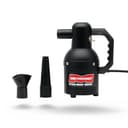
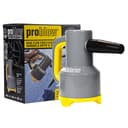
Two products on this page state filtration on their listing: both Adam’s Air Cannons. None of the MetroVac listings we read make a filtration claim in the title, and neither does the Chemical Guys ProBlow. That is a real finding and it is why our top pick is not the most expensive or most powerful tool here.
The logic is the same logic that governs every other contact point on this site. We tell readers to keep towels clean, to use two buckets with grit guards, and to retire a mitt that has been dropped — all because a single hard particle dragged across clear coat is a scratch. A blower does not drag, but it does deliver particles at speed. Filtration is how a dryer avoids being the weak link in a routine you have otherwise been careful about.
What the makers publish — and mostly do not
This category is unusually opaque, so here it is laid out. Every cell is read from the listing; the blanks are the point.
| Tool | Filtered | Motor published | Format |
|---|
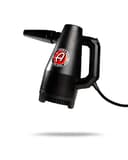
| Adam’s Mini Air Cannon | Yes | Not published | Handheld |
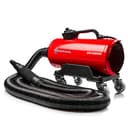
| Adam’s Air Cannon | Yes | Not published | Full-size |
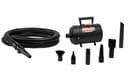
| MetroVac Air Force Blaster | Not published | Not published | Handheld, made in USA |
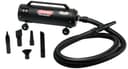
| MetroVac Master Blaster | Not published | 8 HP | Cart, made in USA |
| MetroVac Sidekick | Not published | 1.3 peak HP | Compact, made in USA |
| Chemical Guys ProBlow | Not published | Not published | Handheld |
Worth naming the other thing this table shows: the category is effectively a duopoly. Adam’s and MetroVac between them account for five of our six picks, not because we favour them but because they are who actually makes dedicated, in-stock car dryers in the US market. We have not padded the list with rebadged generic blowers to look more balanced.
How to actually dry a car with one
A blower is not simply a towel replacement you point at the car. The technique that makes it fast:
- Work top down. Roof, glass, hood and trunk, then doors, then lower panels last. Water you push off the roof lands on the doors; do the doors first and you do them twice.
- Push water, do not evaporate it. Hold the nozzle at a shallow angle and drive the sheet of water off the edge of the panel. Aiming straight down at a bead just spreads it.
- Do the gaps and recesses deliberately. Mirror housings, badge surrounds, grille slats, door shuts, fuel filler, wheel faces and the lip under the trunk lid. This is where a blower beats any towel, and where the water that causes those maddening late streaks is hiding.
- Blow out the shuts before you close anything. Open the doors and trunk and clear the channels, or water will run down a clean door an hour later.
- Finish with a towel only if you need to. A blower plus a quick detailer on any remaining spots beats a full towel-dry. If you do use a towel, blot.
Two things make a blower dramatically more effective, and both are upstream. A hydrophobic coating or spray sealant makes water sheet off instead of clinging, so there is far less to move. And a proper final rinse — a flood rinse with the nozzle off rather than a jet — leaves sheets rather than thousands of individual beads.
Do you still need drying towels?
Yes, and anyone who tells you a blower replaces them entirely is overselling. You will still want a towel for the door shuts after you open them, for stubborn spots, and for the interior glass. What changes is that the towel stops being the primary tool contacting 100% of your paint on every wash and becomes a finishing tool used on maybe 10% of it. That is the swirl reduction.
So the realistic kit is a dryer plus one or two good drying towels rather than a dryer instead of them. Our drying towel roundup compares those on published GSM and weave, and how to dry your car without scratching covers the blotting technique for when you do reach for one.
Who should not buy one
Honest limits, because this is a few hundred dollars for a tool that moves air:
- If you have light-coloured paint and wash monthly, the marginal benefit is small. Silver and white hide the swirls that make this worth it on black.
- If you have no power where you wash, every pick here is a corded mains tool. A rinseless wash is the better answer for that constraint.
- If your wash routine is still the problem, fix that first. A blower at the end of a single-bucket wash with a dropped mitt is solving the last 10% of your swirl problem and ignoring the first 90%.