How to choose a dual-action polisher
The most important decision is the one you’ve already made by reading this page: random-orbital, not rotary. A rotary buffer spins the pad on a single fixed axis, which cuts defects fast but builds heat quickly and can strike through an edge or a high spot in seconds. A dual-action machine adds a free-spinning offset so the pad orbits randomly — it’s slower to correct, but it stays cool and stalls instead of digging in. If this is your first polisher, a DA is the answer.
Throw (orbit size): short throw vs 15mm
“Throw” is how far the pad travels on each orbit, and it changes how the tool feels. A shorter 8-9mm throw is more controllable and better for tight areas, mirrors and curved panels — it’s the friendliest place to start. A longer 15mm throw covers more paint per pass and corrects a little faster on big flat panels like a hood or roof, at the cost of feeling more energetic on edges. Neither is “better”; a shorter throw is the safer first machine, a longer throw saves time once you know what you’re doing.
Power and whether the kit includes pads and polish
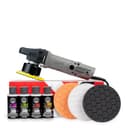
More power (and a stable speed under load) means the pad keeps rotating when you press into a stubborn swirl instead of bogging down — that’s what actually removes the defect. Just as important for a beginner is what comes in the box. Some of these are sold as a bare tool; others are a complete kit that bundles the backing plate, a set of pads and a bottle or two of polish, so you can correct paint the day it arrives without a second shopping trip. If you’re starting from nothing, an all-in-one kit is usually the cheaper and less confusing route.
What about going cordless?
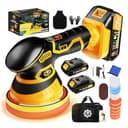
Every machine ranked above is corded, deliberately: for correcting a whole car a cord is cheaper for the same capability and does not fade halfway up the hood. Cordless earns its place on spot work — one panel, a pillar, coating application, or a car parked nowhere near an outlet. We rank those separately in the best cordless car polisher guide, including which battery platform should decide the purchase.
What to do before and after you polish
A polisher only removes defects that are in the paint, so prep matters. Wash the car, then clay bar it to pull bonded contamination before you ever touch it with a pad — polishing over grit just grinds it in. Before machine work the clay step is close to mandatory even on paint that feels clean, and our guide to whether you need to clay bar explains why the usual fingertip test does not get you out of it here. The other accessory worth buying with the machine is a detailing inspection light: holograms and buffer trails from your own pad are invisible under overhead garage lighting and obvious under a beam raked across the panel, so without one you find out whether the correction worked after the car is back in the sun. New to correcting paint? Start with our walkthrough on how to remove swirl marks and the wider paint correction guide so you pick the right pad-and-polish combo. And remember the order of operations: you polish before you protect, because a ceramic coating locks in whatever swirls are underneath it.
Is a DA polisher safe for a beginner?
Yes — it’s the whole reason the tool exists. The random orbit means the pad isn’t driven hard in one direction, so it doesn’t generate the concentrated heat that lets a rotary burn through clear coat. Keep the pad flat, keep the machine moving, start with the least-aggressive pad and polish, and the worst a beginner realistically does is under-correct and have to make another pass. That’s a very different risk profile from a rotary, and it’s why detailers hand first-timers a DA.
If your shortlist has come down to two specific machines, we compared the modern long-throw option against the budget classic on their published specs in Griot’s G9 vs Porter-Cable 7424XP — including the orbit figure one of the two makers does not print.
Whichever machine you pick, budget for pads in the same order - every polisher here is sold either bare or with basic pads you will outgrow. Our polishing pad roundup covers which sets cover a real cut-to-finish range, and which pad diameter fits the backing plate your machine ships with.
Before you buy any of this, it is worth knowing where hand work genuinely suffices. One scuff, a single scratch, a mirror housing or the final gloss step on already-corrected paint are all jobs a machine is the wrong amount of setup for — and doing one panel by hand is the cheapest way to find out whether paint correction is something you enjoy before you spend money on a machine, pads and compound. Can you polish a car by hand? sets out exactly where an arm runs out, and the soap that goes in a foam cannon covers the pre-wash that keeps corrected paint from needing correcting again.