Why a dryer under $200 does not replace a towel
This is the finding that shapes the page, so it is worth being explicit. Drying a car with air alone requires enough volume of moving air to break the surface tension of water across a large flat panel and push the sheet off the edge. That is an airflow problem, and airflow costs money: the three machines our cap excludes sit at roughly double to four times the ceiling, and the biggest publishes 8 HP.
A handheld in the $75 to $135 range does something different and genuinely valuable. It evacuates water from the places that hold it after the towel has gone over:
- Mirror housings and the gap behind the glass
- Badge and emblem recesses, where water sits under a letter for an hour
- Grille and bumper vent slats
- Wheel lug recesses and the gap between the wheel face and the hub
- Panel gaps, door shuts, fuel filler flaps and roof rail channels
- Trim edges, window seal lips and under spoilers
Every one of those is a source of the drip that appears five minutes after you put the towel away — and a drip that dries in the sun on a warm panel is the single most common cause of a fresh water spot, because the mineral content stays behind when the water goes. That is why we rate a cheap blower highly: it does not dry the car, it prevents the spots.
Filtration is a paint-safety spec, not a luxury
A blower pulls air in at one end and accelerates it out of the other. Whatever is suspended in the air near your car goes with it — and you have usually just rinsed brake dust and road grit onto the driveway around the vehicle. Unfiltered, some of that arrives on wet clear coat at speed.
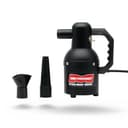
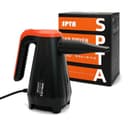
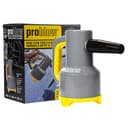
Of the three dryers under this cap, exactly one describes filtered air on its listing. Neither of the other two makes a filtration claim at all. We report that rather than assuming an unstated filter exists, and it is why the cheapest machine here is the one we put second rather than last. Practical mitigation regardless of which you buy: rinse the ground around the car before you start, and keep the nozzle a hand’s width off the paint rather than touching it.
What the $200 cap excludes, and what the extra money buys
A ceiling is only honest if it cuts something off, and this one cuts the category in half. Three registry dryers sit above it:
- Full-size filtered blowers— the Adam’s Air Cannon and the MetroVac Air Force Blaster, at roughly double this ceiling. These are the machines that will sheet water off a bonnet, and both are a different format: floor-standing or shoulder-carried, with a long hose.
- The MetroVac Master Blaster at 8 HP, at roughly four times the cap. This is professional-volume equipment and it publishes the highest power figure in our registry.
What you are buying above $200 is airflow, filtration as standard, and a hose long enough to walk round a car with. What you are not buying is any additional ability to get into a mirror housing — the handhelds do that just as well.
The drying sequence that makes a cheap blower look expensive
- Rinse from the top down and let the water sheet. A final flood rinse with the nozzle off carries most of the water away before you touch anything.
- Blow the wheels and lower panels first, while your towel is still perfectly clean. This is the dirtiest water on the car and the part you least want on a towel you will later use on the roof.
- Blow every gap, mirror, badge and slat. This is the step that stops the drips.
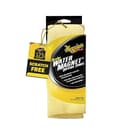
- Towel the flat panels, top down, with a dry towel. Lay it flat and drag, do not scrub. Our drying towel roundup covers weave and GSM in full.
- Use a drying aid if the water is hard. A light mist of quick detailer as you dry adds lubrication and reduces the chance of a mark. If your water leaves spots even when you dry carefully, this is the guide to read.
Honest alternatives to buying a dryer at all
If $200 is the whole budget rather than the dryer budget, the ranking changes. Drying is where most swirl marks are actually inflicted — not washing — so the money is better spent in this order: a good drying towel first, a grit guard bucket second, a decent mitt third, and a blower fourth. A blower is a genuine upgrade, but it is an upgrade to an already-safe process rather than a fix for an unsafe one.
About the prices on this page
Every figure is read live from the price layer and stamped with its own date; nothing is typed into this page. The $200 ceiling is applied against that live data, on November 23, 2026, and the page states the date in prose rather than hard-coding a number that could rot. If the daily refresh ever stops, the numbers disappear and the buttons fall back to “Check price on Amazon” rather than showing you something stale.