How we ranked these
Three criteria, in this order, and the order is the argument.
- Is the bristle material published?Boar’s hair, synthetic and nylon behave differently on gloss trim and differently again under a strong cleaner. A listing that will not name the bristle has not told you what the tool is.
- Does the maker publish rated surfaces?“Safe on all surfaces” is an adjective. “Leather, faux leather, vinyl, plastic, rubber, stainless steel, metal and aluminum” is a commitment you can hold a brand to.
- Does the size spread match a car interior? Three scales of job, so three sizes. Piece count beyond that is packaging, and the small brush is the one that gets used.
Bristle material, and what each one is actually for
This is the section the rest of the page rests on, so here it is without hedging — and with a clear note on where the evidence stops.
Natural boar’s hair: the soft option
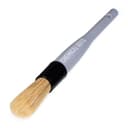
Boar’s hair is the traditional detailing bristle and the softest material here. Chemical Guys’ own page is unusually explicit about the consequence: it gently lifts dirt from “sensitive surfaces like vents, trim, leather, and even glossy panels without scratching”. That is the material to pick when the risk you are managing is marring— gloss-black console trim, badges, a leather dash, a gauge bezel.
Its weakness is chemistry. Natural fiber holds and absorbs liquid and is less resistant to repeated exposure to strong cleaners and degreasers than a synthetic. Use a boar brush with an interior cleaner and it will be fine; make it the brush you scrub wheel wells with using an aggressive APC and it will not last.
Nylon and synthetic: the chemical-resistant option
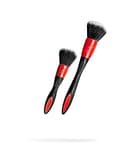
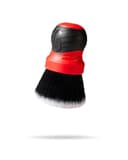
Synthetic bristles are firmer at the same length and, more importantly, indifferent to what you dip them in. That makes them the right choice for carpets, fabric seats, floor mats, door shuts and anywhere you are using a real cleaner rather than a detailer spray. Adam’s large brush names soft nylon and rates it for screens, seats, leather and vinyl — which shows that “synthetic” does not have to mean “harsh”; the grade matters as much as the family.
Blends, and the thing nobody publishes
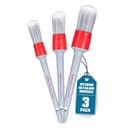
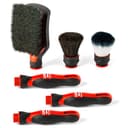
Chemical Guys’ three-piece set uses “premium boar and synthetic bristles” — a deliberate middle: more scrub than pure boar, more gentle than pure nylon. It is a sensible default and a genuine compromise, and you should expect it to be second-best at both extremes.
Now the limit of the evidence, stated plainly, because it is a finding rather than a gap. Not one listing in our set publishes a bristle length, a bristle diameter or a stiffness rating.Griot’s publishes relative grades (super-soft, soft, flat) and not the material; Adam’s small brush publishes neither. So there is no cross-brand stiffness scale on this page, and you will not find one anywhere else that is not invented. Buy on the specs a maker is willing to print, and when in doubt, buy the softer thing — a brush that is too soft costs you a second pass, and a brush that is too stiff costs you a panel.
The four jobs a brush does better than a towel
A brush is not a cleaner. It is an agitator, and it earns its place in exactly the places a folded towel cannot reach or cannot work.
- Vents.A towel bridges the slats; a brush gets between them. Dusty slats are a five-minute dry-brush job — our guide to cleaning car air vents covers why a smell is a completely different diagnosis.
- Seams, switchgear and crevices. Seat stitching, the base of a gear selector, the join between dash and windshield. These are small-brush jobs and nothing else does them.
- Textured plastic. A towel slides over grain; bristles reach into it. This is why a dash can look clean and still be dull.
- Agitating a cleaner on fabric.A brush works product into carpet and upholstery so the chemical does its job before you extract it — see cleaning car carpet and mats.
Technique: four rules that keep brushes safe
Most brush damage is technique, not product, and three of these four come straight from maker guidance.
- Dust dry before you go wet.Chemical Guys’ dashboard guidance is to clear and dust the dash first. A wet brush on a dusty surface makes mud and drags grit; a dry brush lifts the dust out first.
- Mist the brush, not the surface.Both Chemical Guys and Adam’s publish this for vents and switches — product goes into the brush head, which stops cleaner running down inside a vent or into a switch pack. On a touchscreen the rule is stricter still: mist the towel, never the screen.
- Light pressure, let the bristles work. Pressing a brush bends the bristles sideways so the ends stop reaching into the texture you were trying to clean. You get less cleaning and more marring.
- Separate interior brushes from dirty-job brushes.The same rule Chemical Guys publishes for microfiber — keep paint-safe and wheel towels apart — applies here. Brake dust embedded in a bristle is the thing that scratches a dash. Wheel work belongs to dedicated wheel brushes.
What to buy with them
A brush agitates; something else has to carry the dirt away. In practice a brush is the cheap third of a three-part interior setup:
If you want the whole sequence in order rather than a shopping list, our interior detailing guide runs it top to bottom, and the interior detailing kit roundup covers the bundled option if you would rather buy it all at once.
How long should a brush last, and when do you bin it?
No maker in our set publishes a service life, a replacement interval or a bristle-count figure, so there is no honest number to give you. What there is, is a failure mode you can see.
Bristles splay outwards permanently once they have been pressed hard or left standing on their ends in a bucket, and a splayed brush does two bad things: it stops reaching into texture, and its bent ends present their sides rather than their tips to the surface. A cheap detailing inspection lightis also the fastest way to audit your own brush work — raked across a dash or a console it shows the dust still sitting in the grain that overhead cabin lighting hides completely. Store brushes bristles-up or flat, rinse them out after a session with a cleaner in them, and replace one when the bristles no longer come back to shape. A modular kit like Griot’s makes that cheaper, because the handle is not part of the consumable.