
Clay & Coat

Are Ozone Generators Safe for Cars?

The EPA's position is blunt, California will not let one be sold to you, and the listings themselves say to leave the space unoccupied. What that means for a car that smells, and what to use instead.

By Stephen V.Last updated How we pick

How this is funded: we earn a commission if you buy through our links, at no extra cost to you. It never changes which product we recommend, and we’ll tell you when we’d skip one. Full disclosure.

Not in an occupied car, and for a DIY owner we would not use one at all. That is not a cautious hedge — it is what the published sources say, including the product listings. The US EPA’s position on ozone generators sold as air cleaners is that available scientific evidence shows ozone is not effective at removing many indoor air contaminants at concentrations that do not exceed public health standards, and that ozone can irritate the airways. California does not permit these devices to be sold as indoor air cleaners, and the listing for the generator in our own registry carries a “not sold in California” line, states it is for unoccupied spaces only, and requires 30 minutes of airing out after generation ends.

Read those three facts together. A federal agency says the concentrations that work are the concentrations that are hazardous. A state regulator restricts sale. And the seller tells you not to be in the room. None of that is compatible with “plug it into your car for an afternoon”.

What the published guidance actually says

The core of the EPA material is an effectiveness argument before it is a safety argument, which is the part most summaries miss. Ozone is reactive, so it does something — but at concentrations low enough to be within public health standards, the evidence does not support it clearing many indoor contaminants. Raise the concentration until it does, and you are in airway-irritation territory. There is no window where it is both effective and comfortably safe.

California’s regulation approaches the same problem from the device end: indoor air cleaners sold in the state must meet an ozone emission limit, and generators that exceed it cannot be sold there as air cleaners. That is a regulator having examined the category and acted.

Why professional detailers still use it

Because the controlled version is a different activity from the consumer version. A detailer running ozone on a smoke car does it with a timed cycle, nobody in the building, and a long forced ventilation afterwards — conditions a driveway cannot reproduce. If a shop quotes you an ozone treatment on a car you have just bought, that is a legitimate service with a managed process behind it.

What does not follow is buying the box yourself. The published hazard is dose-and-exposure, and dose-and-exposure is exactly what a procedure manages. Also worth noting: not one ozone listing we have read publishes a cabin-specific dose or run time for a vehicle. There is no number to follow.

The three things that fix a smelly car

Air treatment is the last step, not the first, and the order below is the whole content of this page in practical form.

SmellMost likely causeWhat to do
Musty, worse with the AC onCabin filter and evaporatorReplace the filter, then a vent-carried cabin treatment — see the vent guide
Damp, like a basementWet carpet or underlayFind the leak, extract, dry fully before any treatment
Cigarette smokeResidue on every surface, including the headlinerDeep clean all surfaces, then a chlorine dioxide vapor pouch with published dosing
Milk, food, pet accidentOrganic matter in the fabricEnzyme-style cleaning and extraction — a gas will not remove the source
DogHair and oils in the fabricHair removal first, then clean, then absorb
Nothing obvious, car is cleanResidual, low-levelBamboo charcoal absorber, left in place

Notice that no row says “ozone”. Every genuine cause is either a cleaning job or a documented treatment with published dosing, and the two treatments below are the ones that publish numbers.

The rule that applies to every treatment here

Unoccupied car. No people, no pets, no plants. Meguiar’s says it explicitly for its cabin aerosol; Star brite says to ventilate the vehicle after the chlorine dioxide treatment; the ozone listing says unoccupied spaces only and 30 minutes of airing. These are not identical products or identical risks, but the operating rule is the same, and the only item on this page that breaks it is the charcoal bag — because it absorbs instead of reacting.

If anyone who uses the car has asthma or another respiratory condition, our answer narrows further: deep clean, replace the cabin filter, and use the charcoal. That combination is effective on most cars and carries no inhalation question at all.

What to use on a car that smells, instead

Ranked on published specs, coverage and buyer fit. Select a row to jump to the full write-up. We haven’t tested these in a lab — here is exactly what we do instead.

#ProductBest forPrice
1
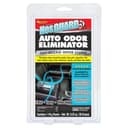
Star brite NosGUARD SG Auto Odor Eliminator

Star brite NosGUARD SG Auto Odor Eliminator

The heavy option for a smell that has soaked into everything, cigarette smoke above all. It is a chlorine dioxide treatment: you wet the sponge, seat the sealed pouch in it, set the container near the middle of the car and let the vapor work. Star brite says one pouch treats up to 1,000 cubic feet with significant odor reduction in 4 to 6 hours, and it names its chemistry, which we like. The price is an afternoon without the car and a gas you should not breathe - keep people and pets out while it works, and ventilate the car afterward as Star brite's own listing directs.

Best for smoke and odors soaked into every surface
$13.17 · View on Amazon

Price as of October 17, 2026. #ad How we’re funded

2
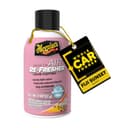
Meguiar's Whole Car Air Re-Fresher Mist (Fiji Sunset)

Meguiar's Whole Car Air Re-Fresher Mist (Fiji Sunset)

The one to buy when the smell lives in the car's air, not just its carpet. It is a one-time aerosol you set off in a closed car with the AC on recirculate, so the mist is carried through the vents and across the headliner - places a spray bottle never reaches. Meguiar's own directions are the most honest thing about it: remove the source and clean soiled carpet first, one can per vehicle, nobody inside. Follow them and it is the best single step on this page; skip the cleaning and it is an expensive air freshener.

Best for a stale smell coming from the vents
$9.99 · View on Amazon

Price as of October 17, 2026. #ad How we’re funded

3
Moso Natural Car Air Purifying Bag (bamboo charcoal)

Moso Natural Car Air Purifying Bag (bamboo charcoal)

The pick for anyone who wants the car to smell of nothing at all. It is a linen bag of bamboo charcoal that absorbs odor and adds no fragrance, and it is reusable: Moso says an hour in the sun once a month keeps it working for up to two years, so spread over its rated life, the cost per month in the table above is small. What it cannot do is outwork an active source. It is the finishing step after the cleaning, exactly as our odor-removal guide lays out.

Best for keeping a clean car neutral, with zero risk
$14.95 · View on Amazon

Price as of October 17, 2026. #ad How we’re funded

#1Top pick — Best for smoke and odors soaked into every surface

Star brite NosGUARD SG Auto Odor Eliminator

The heavy option for a smell that has soaked into everything, cigarette smoke above all. It is a chlorine dioxide treatment: you wet the sponge, seat the sealed pouch in it, set the container near the middle of the car and let the vapor work. Star brite says one pouch treats up to 1,000 cubic feet with significant odor reduction in 4 to 6 hours, and it names its chemistry, which we like. The price is an afternoon without the car and a gas you should not breathe - keep people and pets out while it works, and ventilate the car afterward as Star brite's own listing directs.

Cost per treatment≈ $13.17based on ~1 treatments per unit at the current price (as of October 17, 2026)

Who it is for:someone who has bought a car that smells of cigarettes and has already deep-cleaned it. This is a chlorine dioxide vapor treatment, and Star brite publishes real numbers: one pouch treats up to 1,000 cubic feet, with “significant odor reduction within 4-6 hours”, after which you ventilate the vehicle. A car cabin is a fraction of 1,000 cu ft, so one pouch is a generous dose.

Honest cons: chlorine dioxide is a reactive gas with its own handling requirements — the car must be unoccupied during treatment and aired out afterwards, exactly like ozone. It also does nothing about the source: if there is a spill under the carpet, it will come back.

Strengths

  • Names its chemistry - chlorine dioxide - and is sold as removing odors at the source rather than masking them
  • One pouch treats up to 1,000 cubic feet, with significant odor reduction within 4 to 6 hours (Star brite)
  • The vapor reaches into fabrics and hard-to-clean areas that a spray bottle misses (Star brite)
  • Sold and shipped by Amazon

Trade-offs

  • Breathing chlorine dioxide gas can irritate the nose, throat and lungs (ATSDR) - nobody should sit in the car during treatment, and it needs airing out afterward
  • The car is out of use for hours, not minutes
  • A one-time treatment - each pouch is used up, so a returning smell means another purchase
  • Setup is fiddlier than a spray: a sponge to wet and a sealed inner pouch that you must not open (Star brite)
What it isChlorine dioxide vapor treatment, one pouch per up to 1,000 cu ft
Size0.35 oz pouch
CoverageOne pouch treats up to 1,000 cubic feet (Star brite)
What it doesEliminate - chlorine dioxide vapor
Where it reachesThe whole cabin, including fabrics (Star brite)
Treatment timeSignificant odor reduction within 4-6 hours (Star brite)
AfterwardVentilate the vehicle (Star brite)

Specs read from the product listing, on September 22, 2026. “Not published” means the brand does not state that figure.

#2Best for a stale smell coming from the vents

Meguiar's Whole Car Air Re-Fresher Mist (Fiji Sunset)

The one to buy when the smell lives in the car's air, not just its carpet. It is a one-time aerosol you set off in a closed car with the AC on recirculate, so the mist is carried through the vents and across the headliner - places a spray bottle never reaches. Meguiar's own directions are the most honest thing about it: remove the source and clean soiled carpet first, one can per vehicle, nobody inside. Follow them and it is the best single step on this page; skip the cleaning and it is an expensive air freshener.

Cost per treatment≈ $9.99based on ~1 treatments per unit at the current price (as of October 17, 2026)

Who it is for:the car that smells musty when the air conditioning comes on, where the problem is the evaporator and the ductwork rather than the seats. Meguiar’s publishes the method clearly: one 2 oz can per vehicle per treatment, set off with the AC recirculating so the aerosol is carried through the vents and the headliner, about 15 minutes closed and then 5-10 minutes airing out.

Honest cons: it eliminates and then scents, so you do not get a neutral result — and Meguiar’s publishes no figure for how long the scent lasts. Like everything here, the car must be empty of people, pets and plants during use.

Strengths

  • Uses the car's own recirculated air to carry the mist through the ventilation system and across the headliner (Meguiar's)
  • Meguiar's directions tell you to remove the odor source and clean soiled carpet first - the maker does not pretend a can replaces cleaning
  • No tools and under half an hour start to finish: fan on high, set it off, close the doors for about 15 minutes, then air the car out
  • Sold and shipped by Amazon, and Meguiar's makes it in nine scents if Fiji Sunset is not yours

Trade-offs

  • One can is one treatment - Meguiar's says not to use more than one can per vehicle at a time, so a smell that comes back means buying another
  • The engine idles with the fan on high for the whole treatment; Meguiar's says to do it in a well-ventilated area, which rules out a closed garage
  • It leaves a fragrance behind by design - not the pick if you want a car that smells of nothing
  • The timings differ slightly between the listing (10-15 minutes closed, 10-15 airing out) and Meguiar's page (15 minutes closed, 5-10 airing out) - follow the can
What it isOne-shot aerosol cabin treatment carried through the vents, 2 oz
Size2 fl oz
CoverageOne can per vehicle per treatment (Meguiar's)
What it doesEliminate, then scent - a one-time-use aerosol you set off and leave
Where it reachesVents and headliner, via recirculated AC air (Meguiar's)
Car occupied during use?No - no people, pets or plants inside (Meguiar's)
Time out of useAbout 15 minutes closed, then 5-10 minutes airing out (Meguiar's)
How long the scent lastsNot published

Specs read from the product listing, on September 22, 2026. “Not published” means the brand does not state that figure.

#3Best for keeping a clean car neutral, with zero risk

Moso Natural Car Air Purifying Bag (bamboo charcoal)

The pick for anyone who wants the car to smell of nothing at all. It is a linen bag of bamboo charcoal that absorbs odor and adds no fragrance, and it is reusable: Moso says an hour in the sun once a month keeps it working for up to two years, so spread over its rated life, the cost per month in the table above is small. What it cannot do is outwork an active source. It is the finishing step after the cleaning, exactly as our odor-removal guide lays out.

Cost per month≈ $0.62based on ~24 months per unit at the current price (as of October 17, 2026)

Who it is for: anyone who wants the car to smell of nothing, and the only option on this page that is safe to leave in an occupied vehicle. Activated bamboo charcoal absorbs rather than reacts: 300 g of charcoal rated for up to 90 sq ft, reusable up to two years with an hour in the sun once a month to refresh it.

Honest cons: absorption is slow and passive. It will keep a cleaned cabin neutral and take the edge off a mild smell over days; it will not rescue a car that reeks of smoke. For that you need the deep clean first and a vapor treatment second.

Strengths

  • Adds no fragrance - it absorbs odor instead of covering it
  • Reusable for up to 2 years with an hour in the sun once a month (Moso Natural)
  • Moso says it also absorbs excess moisture and the musty smell that comes with it
  • Nothing to spray, spill or plug in, and Moso says it is safe to leave in a hot car

Trade-offs

  • Passive and slow - it soaks up a lingering smell but cannot keep pace with an active source like a spill or a moldy cabin filter
  • It only keeps working if you remember the monthly hour in the sun
  • Sold by Moso Natural rather than by Amazon
  • The Amazon listing does not state the charcoal weight; Moso's own page says 300 grams, for spaces up to 90 square feet
What it isFragrance-free bamboo charcoal odor absorber, reusable up to 2 years
Size300 g of charcoal (Moso Natural's page)
CoverageUp to 2 years with an hour in the sun each month (Moso Natural). We figure 24 months.
What it doesAbsorb - activated bamboo charcoal
ScentNone
Rated spaceUp to 90 sq ft (Moso Natural)
UpkeepAn hour in the sun once a month (Moso Natural)

Specs read from the product listing, on September 22, 2026. “Not published” means the brand does not state that figure.

The order that actually fixes a smelly car

  1. Find the source. Lift the mats, check under the seats, press the carpet with a paper towel to look for moisture, and open the cabin air filter housing. A smell with a cause is a cleaning job, not an odor-treatment job.
  2. Replace the cabin air filter. Cheap, usually ten minutes, and routinely the entire problem on a musty car.
  3. Deep clean the fabric.Extract the carpets and seats and let them dry fully — damp fabric is the smell. See carpet and mats and car seats.
  4. Then, and only then, treat the air. A vapor treatment on a clean car works. On a dirty car it buys you a week.

Our full guide to getting smells out of your car walks through the diagnosis, and the air freshener roundup covers the eliminate-versus-mask distinction across every format.

A note on safety. Nothing on this page should be run in an occupied vehicle. Every treatment here — including the two we recommend — is applied to an empty, closed car and then aired out before anyone gets in. No people, no pets, no plants. Chlorine dioxide and ozone are both reactive gases; a bamboo charcoal bag is the only product on this page that is inert. If anyone in the household has asthma or another respiratory condition, use the charcoal and the deep clean, and skip the gas treatments entirely.

Frequently asked questions

Are ozone generators safe to use in a car?

Not in an occupied one, and that is not a disputed point - the product listings say so themselves. The listing for the generator in our own registry states it is for unoccupied spaces only and requires 30 minutes of airing out after ozone generation ends. The US EPA's position on ozone generators sold as air cleaners is that available scientific evidence shows ozone is not effective at removing many indoor air contaminants at concentrations that do not exceed public health standards, and that ozone can irritate the airways. California does not permit these devices to be sold as indoor air cleaners, and the listing itself notes it is not sold in California. Our position: for a DIY car owner there is no recommendable use case here.

Does ozone actually remove smoke smell from a car?

Professional detailers do use ozone on smoke, under controlled conditions, with timed unoccupied cycles and long ventilation afterwards - and that is the honest context for any success story you read. What the EPA publishes is that ozone is not effective at removing many indoor contaminants at concentrations that stay within public health standards, and high concentrations are where the risk is. So the version that works is the version that is hazardous, run by someone whose job it is. A chlorine dioxide pouch treatment with published dosing is the DIY-appropriate alternative.

Why can't you buy an ozone generator in California?

California regulates indoor air cleaning devices by ozone emission, and devices that emit ozone above the state limit cannot be sold there as air cleaners. That is why the listing for the unit in our registry carries a 'not sold in California' line. It is worth reading that as a data point rather than a quirk: a state air regulator looked at this product category and restricted it. If you are weighing whether ozone in a cabin is a good idea, that restriction is the clearest published signal available.

How long after using ozone is a car safe to drive?

The listing for the generator in our registry specifies 30 minutes of airing out after ozone generation ends. Treat that as a minimum rather than a target, open every door, and do not sit in the car while it clears. Ozone has a short half-life in air, which is the mechanism behind any 'it dissipates' reassurance - but a sealed car is not well-ventilated air, and the smell of ozone lingering is a sign the concentration has not dropped. If you can smell it, keep the doors open.

Is chlorine dioxide safer than ozone for a car?

It is the better-documented option for DIY use, which is not the same as harmless. Star brite publishes dosing (one pouch per up to 1,000 cubic feet), a timeframe (significant odor reduction within 4-6 hours) and an instruction to ventilate afterwards - so you can follow a procedure the manufacturer wrote. Ozone generators in a car come with no cabin-specific dosing at all. Chlorine dioxide is still a reactive gas: unoccupied car, no pets, air it out properly.

What is the safest way to get a smell out of a car?

Find the source and remove it, then absorb what remains. In order: pull the mats and look for a spill, replace the cabin air filter, extract and fully dry the carpets and seats, clean the vents, and then put a bamboo charcoal bag in the car to keep it neutral. Every step in that list is safe to do with the family using the car normally, and together they fix the large majority of smelly cars. Gas treatments are for after a deep clean has not been enough.

Will an ozone generator damage a car interior?

Ozone is an oxidiser, which is the whole basis of the odor claim, and oxidisers act on rubber and some plastics as well as on smells. Neither the EPA material nor the product listing publishes a figure for interior material degradation in a vehicle, so we are not going to put a number on it - but 'strong oxidiser, enclosed cabin, long exposure' is not a combination with an obvious upside. The published health guidance is the stronger reason to avoid it; the material question is a second one.

Sources

  • US EPA — Ozone Generators that are Sold as Air Cleaners — Ozone damages the lungs; at concentrations that do not exceed public health standards it has little potential to remove indoor air contaminants and is not effective at removing many odor-causing chemicals; its reactions can form harmful or irritating by-products (accessed September 22, 2026)
  • California Air Resources Board — Hazardous Ozone-Generating Air Purifiers — CARB recommends ozone generators not be used except for approved industrial purposes where harmful exposure is prevented; ozone is only partially effective at cleaning air at extremely high, unsafe levels (accessed September 22, 2026)
  • Star brite — NosGUARD Auto Odor Eliminator — Maker's page: chlorine dioxide vapor system; one pouch treats up to 1,000 cubic feet; significant odor reduction within 4-6 hours; ventilate the vehicle after treatment; wet the sponge and do not open the inner white pouch (accessed September 22, 2026)
  • Meguiar's — Whole Car Air Re-Fresher (G16402) — Maker's page: the mist moves through the ventilation system and across the headliner; vehicle unoccupied with no people, pets or plants; remove odor sources and clean soiled carpet first; park in a well-ventilated area; no more than one can per vehicle at a time; fan on high, doors closed 15 minutes, air out 5-10 minutes (accessed September 22, 2026)
  • Moso Natural — Car Air Purifying Bag — Maker's page: unscented bamboo charcoal odor absorber; lasts up to 2 years if placed in the sun for one hour once a month; 300 grams of charcoal; covers up to 90 square feet (accessed September 22, 2026)
  • ATSDR (CDC) — Chlorine Dioxide & Chlorite ToxFAQs — Breathing air containing chlorine dioxide gas may cause nose, throat and lung irritation; chlorine dioxide is a reactive gas that breaks down quickly in the environment (accessed September 22, 2026)
  • US EPA — Pesticide Devices: A Guide for Consumers — An EPA establishment number on device packaging does not indicate EPA reviewed the product for safety or efficacy, and does not imply approval, registration, certification or endorsement (accessed September 22, 2026)

Keep reading