Gloss, satin and matte are three different problems
People say “black wheels” as if it is one finish. For cleaning purposes it is three, and knowing which you own changes how careful you need to be.
Gloss blackbehaves like painted bodywork. It is the most forgiving of the three chemically, and the least forgiving visually — it holds a reflection, so any hazing from an aggressive cleaner shows up as a loss of depth you will notice every time you walk past. Satin and matte blackare the opposite: they hide fine marks, and they are ruined by anything that makes the surface shinier. A matte finish that has been etched or polished in patches cannot be “re-mattened” with a product, which is why matte wheels are the single strongest argument for buying the cleaner whose maker names matte on the label. Black chrome or dark PVD is a plated finish, thinner than you think, and should be treated as the most delicate of the three.
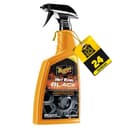
Meguiar’s Hot Rims Black is the pick that covers all three by name, which is the whole reason it is first. Nothing else on this page distinguishes between them.
Acid-free, pH-balanced, acid-based: what the words mean
The wheel-cleaner aisle uses three overlapping phrases and only two of them tell you anything.
Acid-based cleaners dissolve brake dust fast and are genuinely effective on bare, unpainted or chrome wheels. They are also the ones that stain, haze and etch a coated finish, and they are the reason this page exists. If a label does not say acid-free, treat it as acidic until proven otherwise.
Acid-free is a chemistry statement: the cleaner is doing its work by detergency or by chelating iron rather than by attacking the deposit with an acid. That is the claim you want on a black wheel. pH-balancedis a narrower claim about the formula sitting near neutral. Four of the five products here publish one or both phrases. Not one of them publishes an actual pH number, and we are not going to invent one — a brand that will not print the figure has told you something by omission.
One more practical rule that no label will give you: never let any wheel cleaner dry on the wheel. Most of the horror stories that get blamed on “the wrong cleaner” are actually the right cleaner left to bake on a hot wheel in the sun. Work one wheel at a time, on a cool wheel, in the shade, and rinse before it flashes off.
Why black wheels look dirty faster
They do not, really — they show a different kind of dirt. Brake dust is fine, dark, metallic and the single biggest source of wheel grime on any car; on a silver wheel it reads as a gray film, and on gloss black it reads as a loss of reflection, which your eye picks up at a distance. The flip side is that black wheels hide the orange-brown iron staining that makes a silver wheel look permanently rusty.
That asymmetry has a maintenance implication worth acting on: because black hides staining, you can run black wheels further into contamination without noticing. The dust is still bonding into the coating while the wheel looks acceptable. A quick test — run a clean, wet fingertip across the face. If it feels gritty rather than slick, you are past detergent territory and want the iron-reactive pick, whatever the wheel looks like.
A cleaner is half the job. The other half is a brush
No cleaner on this page gets inside the barrel, and the barrel is where brake dust packs in hardest. Spraying more chemistry at a barrel you cannot reach is the most common waste of money in wheel care. You want a long, soft brush for the barrel and a smaller one for the lug recesses — and on black wheels the softness matters more than usual, because a stiff bristle will scuff a satin coating all on its own. Our wheel brush picks cover the shapes worth owning, and how to clean wheelshas the full order of operations — dedicated bucket, wheels first, rinse before anything dries.
If your wheels are bad enough that you are considering the heavy-duty route, consider decontaminating them chemically instead. A dedicated iron remover does the same job as an acid without the acid, and the same product then cleans the lower paintwork where fallout lands.
Protect the finish and this gets much easier
The best thing you can do for a set of black wheels is make the next clean easier rather than buying a stronger cleaner. A coating on the wheel face means brake dust sits on a slick layer rather than keying into the paint, and a pressure rinse takes most of it off before a brush touches the finish — which on a matte wheel is the difference between a long life and a patchy one. We cover the specifics in ceramic coating for wheels.
And finish the job properly: dress the tires after the wheels are clean and dry, not before, or you will spend the next week watching sling marks appear on the paint. Our tire shine picks and application guidedeal with that, and while the wheels are off the ground it costs nothing to check pressures and tread — NHTSA’s guidance is to check pressure monthly when cold and replace at 2/32-inch tread depth.