The four questions that decide it
Work through these honestly and the answer falls out. There is no best machine here, only a best machine for the way you actually clean a car.
1. Will you ever put liquid in it?
This is the big one, and it is binary. If you are ever going to shampoo a carpet, extract a spill, deal with a leaking sunroof footwell or clean up melted snow and road salt, you need a wet/drymachine, and no handheld on the market is one. Running liquid through a dry-only vacuum destroys the motor. If the answer is no — you vacuum dry debris and that is all — the capability is dead weight.
2. Is there an outlet where the car lives?
A shop vac needs mains power and a hose that reaches all four footwells, which in practice means a garage, a driveway with an outdoor socket, or a very long extension lead. If your car lives on the street or in an open apartment lot, a shop vac is a machine you will carry out twice and then stop using. Cordless or 12V wins on utilization, which beats winning on suction.
3. How dirty does the car actually get?
Pet hair, kids, sand, sports gear and job-site dust are shop-vac problems. Suction and airflow are what pull hair out of a woven carpet, and a handheld running on a battery does not have either in reserve. A commuter car with a tidy owner is a handheld problem — the debris is light, the sessions are frequent and short, and the machine that gets used is the one that is easy to pick up. Pet hair in particular is its own category; we cover it in best car vacuum for pet hair.
4. Where will it live?
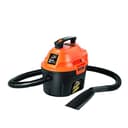
A 5-gallon canister plus a hose plus attachments takes a corner of a garage. That is trivial if you have a garage and a dealbreaker if you do not. The 2.5-gallon class exists precisely for this reason, and it is why our overall pick sits there rather than at either extreme.
Where a shop vac genuinely wins
Two places, and they are worth being specific about. The first is sustained suction under load. A corded motor drawing mains power does not care that it has been running for twenty minutes or that the carpet is dense; a battery tool fades on both counts, and the fade is why people conclude a handheld “doesn’t pick anything up” when it did fine for the first three minutes.
The second is wet extraction, which quietly unlocks the single biggest improvement available to a tired interior. Shampooing a carpet is not the hard part — getting the water back out is, and a wet/dry vacuum is the only tool here that does it. A carpet cleaned without extraction stays damp, and the US EPA’s mold guidance is blunt about what follows: the key to mold control is moisture control, materials should be dried within 24 to 48 hours, and porous materials such as carpet that become moldy may need replacing. Soaking a car’s carpet with no way to pull the water back out is how a clean car becomes a musty one. Our carpet and mats guide covers the method.
Where a car vacuum genuinely wins
Reach and tolerance for small jobs. A handheld goes between the seat and the console, under the seat rails and along the door pockets without reconfiguring anything, and crucially you will do it on a Tuesday evening for five minutes. A shop vac is a project; a handheld is a habit, and over a year the habit cleans the car more.
Noise and neighbours. A full-size wet/dry vacuum at full power in a shared parking lot or an apartment garage is antisocial in a way that affects whether you use it. This is a real constraint and it is almost never mentioned in a comparison.
Filtration honesty. Neither class wins outright here, and we are not going to pretend otherwise: none of the vacuums in our registry publishes a filtration rating we could rank on, so this page carries no filtration comparison. What is true in general is that fine dust is the hardest thing for any vacuum to retain, and if you are blowing dust out of vents it is going somewhere. We prefer a filtered blower for vent and crevice work for exactly that reason.
The answer most people should act on
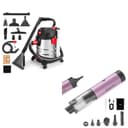
Own both, and spend the money asymmetrically. A 2.5-gallon wet/dry machine at home covers suction, capacity and wet pickup for the quarterly deep clean, and a cheap 12V or cordless handheld in the trunk covers the weekly five-minute pass that actually keeps the interior presentable. Together they cost less than one premium cordless stick vacuum and cover situations neither category covers alone.
If it has to be one machine: choose on question 2. Outlet where you park, buy the wet/dry. No outlet, buy the cordless and accept that a serious carpet clean is a job for a car wash bay or a detailer. Everything else is secondary to whether the machine can actually be plugged in where the car sits. Our full ranking of every machine in both classes is on best car vacuum for detailing, and the order the interior should be cleaned in is in how to detail your car interior.